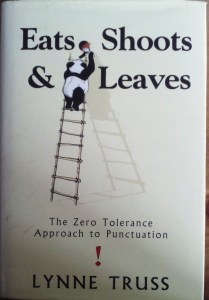
If, like me, you cringe at the sight of the misplaced apostrophe and other grammatical ‘nasties’, then Eats, Shoots and Leaves is a ‘must-read’ for you.
Lynne Truss offers us her ‘Zero Tolerance Approach to Punctuation’ as an antidote to ignorance and indifference in the use and application of full stops, commas, question marks and more.
Full of rich and ridiculous examples of how the meaning of the English language can be distorted by the misuse, over-use and lack of use of correct punctuation, this is a hugely entertaining read.
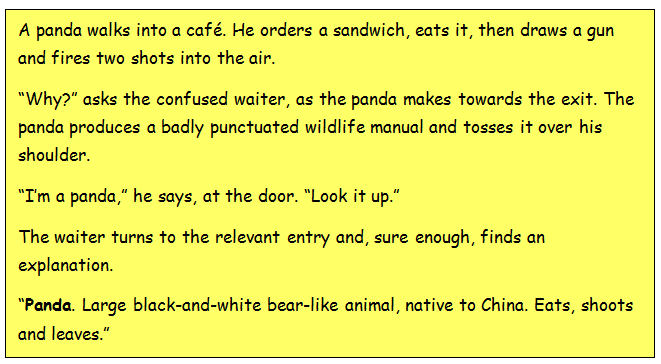
Why the title?
So thoughtfully and wittily written, if you haven’t already come across it, I commend this book to you!
Find iton Goodreads and check out what other people have to say.
Some find it too preachy, but then I suspect that they’re not grammar gurus or punctuation pendants like me. I mean, who else kicks up a fuss in a Chinese chippy late at night at the sight of baked potatoe’s on the menu? Oh, really? You do? Good for you!
Written by Joe Moran, professor of English and Cultural History at Liverpool John Moores University and author of ‘Armchair Nation: An Intimate History of Britain in Front of the Television’.
Courtesy of Guardian News & Media Ltd
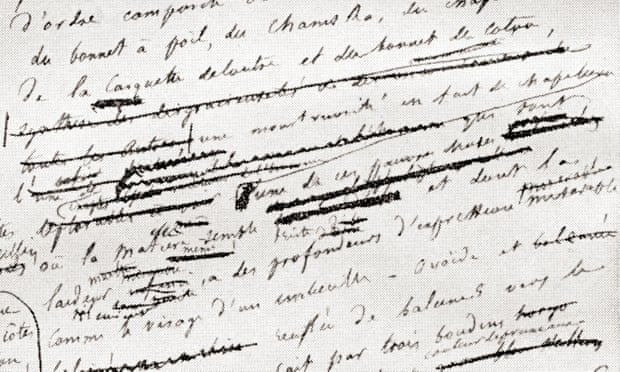
Extract from a page of Gustave Flaubert’s manuscript of Madame Bovary. Photograph: Alamy Stock Photo
Orwell advised cutting as many words as possible, Woolf found energy in verbs, and Baldwin aimed for ‘a sentence as clean as a bone’. What can we learn from celebrated authors about the art of writing well?
Every writer, of school age and older, is in the sentences game. The sentence is our writing commons, the shared ground where all writers walk. A poet writes in sentences, and so does the unsung author who came up with “Items trapped in doors cause delays”. The sentence is the Ur-unit, the core material, the granular element that must be got right or nothing will be right. For James Baldwin, the only goal was “to write a sentence as clean as a bone”.
What can celebrated writers teach the rest of us about the art of writing a great sentence? A common piece of writing advice is to make your sentences plain, unadorned and invisible. George Orwell gave this piece of advice its epigram: “Good prose is like a windowpane.” A reader should notice the words no more than someone looking through glass notices the glass.
Except that you do notice the glass. Picture an English window in 1946, when Orwell wrote that sentence. It would be smeared with grime from smoke and coal dust and, since houses were damp and windows single-glazed, wont to mist and ice over. The glass might still be cracked from air-raid gunfire or bombs, or covered with shatterproof coating to protect people from flying shards. An odd metaphor to use, then, for clear writing.
I was nominated for this award byVickleawho has been very supportive of my writing since I started posting at the start of this year. I’m very pleased because it’s given me an opportunity to share an example of how some people help each other in my adopted country, South Africa.
South Africa is one of the most unequal countries in the world. We have the very, very rich (a small number) and the very, very poor (sadly many more). We may think we’re somewhere in the middle, but the vast majority of the population live on very little.
We are fortunate enough to be able to afford to employ a housekeeper, Joyce, and a gardener / handyman, Johannes, a couple of days a week. This sounds quite grand, or at least it seemed to me to be so when we first came over here. We don’t necessarily need the help, although it’s nice to have someone to do the housework and look after the garden. It also gives us an excuse to help them to support their families.
However, this is not about us in our privileged position and what we do, rather I want to share something which Joyce did for one of the kids in her neighbourhood last week.
Joyce was standing by the gate to her little rented house having just seen her youngest child Joshua and her grandchild, Lesego, off to school. She was watching some of the other children make their way to school when she noticed a little boy of about Joshua’s age struggling to walk in gum boots which were much too big for him. She could see by how he was dressed that he came from a family who must have very little to spend on clothes and shoes. She called him over and saw that he was crying. He said it was because the gum boots hurt his feet and made it hard for him to walk.
Joyce told him to wait by the gate. She fetched a pair of Joshua’s shoes. The shoes were in good condition and still fit Joshua, but he did have his school shoes and a pair of trainers as well and Joyce decided that she must give them to the little boy who was struggling. He tried them on and they fit. He was over the moon! Joyce gave him a plastic bag for the gum boots and off he ran to school so as not to be late. On his way back that afternoon, he came and thanked Joyce again.
When she told me, I could see how happy she was to have been in a position to help the little boy, even though she herself manages on a very modest budget as a single mum, with a grown up daughter and son, another son who’s studying civil engineering and the two little ones.
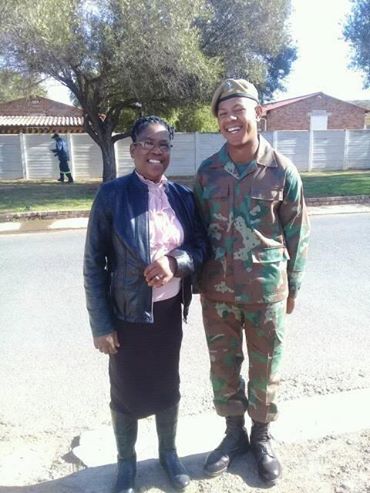
Joyce with eldest son, Thulani, who’s in the computer section of the army (he’s not keen on guns)
Lesego and Joshua, the two little ones
Award Rules
All through life we encounter people who for no particular reason help someone out, or extend a hand when needed. Some do it directly and some do it indirectly. 1- copy or paste image for reward on your post. 2- Write about a random act of kindness, either you saw, was given to you, or you have done. It is okay to spread the love people. You don’t have to name specific names or whatever but tell us about it. 3- Share this award and link to original post or tag the person who nominated you. 4- If you should want to do this then you can leave an open ended invitation, or personally tag others. 5- Pictures are a good share to, if you have pictures to share a random act of kindness, that is great!
I’m leaving this Award open to anyone who might read this and like to share something good. There’s too much bad stuff in the world.
I’m a huge fan of David Mitchell’s novels; I just love his writing. Then I came upon this article in The New Yorker. It fascinated me, particularly since I’ve been trying to sketch a map of the (only partly fictional) tunnels which run under the city of Liverpool to help in the process of writing my current novel.
My writing buddy, Paul English, with whom I regularly meet for coffee to chat about our writing, recently published the second novel in his Superhero series. We’ve many times discussed how difficult it is to do one’s own publicity, but doing for someone else is much easier. The article will appear in the school magazine, and I shall be submitting it to our local paper.
New Superhero Books for School Library
Somerset West author, Paul English, has a new audience for his superhero novels. The first two books published in Paul’s Fire Angel Universe Series, ‘Fire Angel: Genesis’ and ‘Fire Angel: Turning Point’, have now been donated to the library of the International School of Cape Town by Cliff Davies, Head of Geography, who won them in an on-line competition run by the author through his Facebook fan page: https://www.facebook.com/FireAngelUniverse
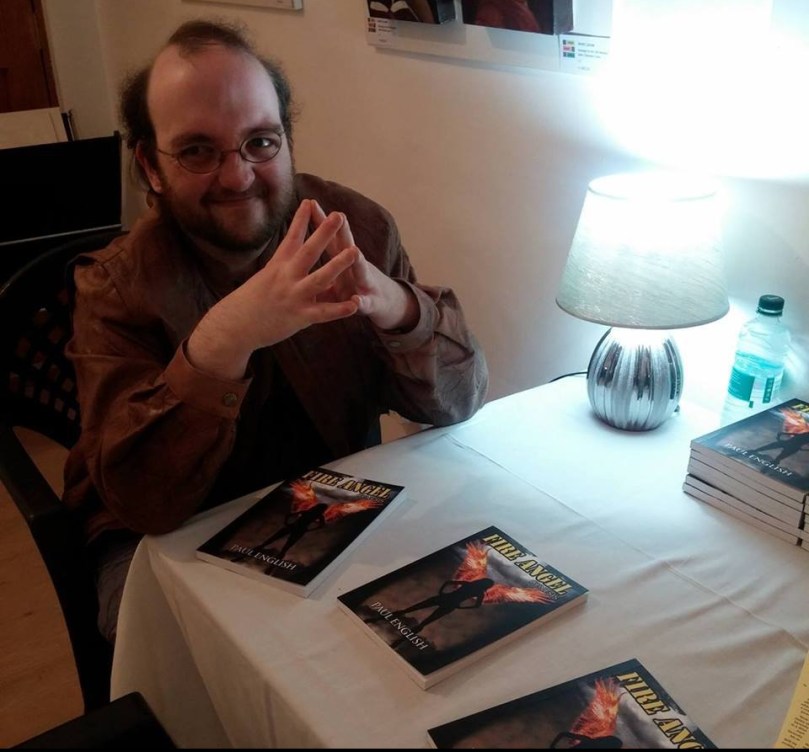
Paul English at a book signing of his debut novel, ‘Fire Angel: Genesis’
Although you wouldn’t think it when you read his books, Paul has faced many difficult physical challenges in his life. The unexplained and undiagnosed syndrome with which he was born has affected both his sight and hearing throughout his 38 years. Nor has he an academic background, having left school after Grade 9. Paul says he found school boring as he felt it kept him from his drawing and writing!
The children’s TV series ‘Transformers’ first awoke the desire to write when Paul was just seven years old. Putting together his combined talent for writing and drawing, he has produced dozens of hand drawn comic books over the years.
Later the inspiration to create his own Superhero came from listening to an interview with Stan Lee about how he came up with Spider-Man and the Marvel Universe. After a few attempts to start his novel, Paul took a course in Creative Writing, which gave him a much better foundation. He regrets not having done that first of all and earnestly recommends this to aspiring writers.
Paul did not want to copy the stereotypical male hero with a perfect body and all the techno gadgets. His Superhero is Haley, a sassy but kind-hearted teenager living in a crime ridden working class neighbourhood, with fears of retrenchment looming over her parents.
In Paul’s first novel, ‘Fire Angel: Genesis’, Haley caught in the impact of a crashing meteorite which gives her some very unusual powers. Soon she is being hounded by unscrupulous people who want to harness her superpowers for themselves. Haley quickly learns not to trust anyone, especially not the scientists who have their own secret agenda.
In the sequel, ‘Fire Angel: Turning Point’, we meet a new superhuman, ‘Nemesis’, who brings death and destruction to all who have wronged her. A confrontation with her leads Haley down the dark path which she has set on. Haley faces some tough choices about whether she will return to defend her community or not.
Paul admits that there is a bit of him in Haley: courage in the face of difficulties, played down by a quirky sense of humour. Asked what his message to fellow writers would be, Paul says: ‘write the story you’d want to read.’
If you’d like your very own copies, ‘Fire Angel: Genesis’ and ‘Fire Angel: Turning Point’ are available as a double pack directly from Paul, priced at R270,00.
The third book in the series, ‘Fade’, will be published soon. The fourth novel is well underway and Paul has already come up with several more ideas for future books in the series.
There is one indispensable step to writing, and that is that you must sit down and write.
This is technically untrue, and was not such a hard and fast rule in the ancient days: Homer, said to be blind, would have been functionally illiterate; he worked the great epics in his head and presented them to live audiences. What we have now are versions likely written down by scribes taking dictation.
The following article is from a book calledWriters and Their Cats,which is a book about writers and their cats (!) and is written by Alison Nastasi.
The writers:
Angela Carter, Chester Himes, Gillian Flynn, Jorge Luis Borges, Judy Blume, Julio Cortázar, Mark Twain, Marlon James, Patricia Highsmith, Ursula K. Le Guin.
‘Roget’ by Thomas Pettigrew 1842, print of portrait, Medical Portrait Gallery
ROGET’S THESAURUS
Not a rare type of dinosaur, this wonderful list of vocabulary on a large scale, categorized by topics has earned an enduring reputation as a handy aid to composition. Nouns, verbs and adjectives are all widely represented, although not the dreaded adverb.
Roget’s Thesaurus was born out of need. As a young and busy doctor, who was much given to lecturing, Peter Mark Roget felt the need to improve his powers of expression.
A compulsive list-maker from the age of eight, Roget devised a ‘classed catalogue of words’ for his own use in 1805. However, it was not until he was in his seventies in 1852, that the first edition, called the ‘Thesaurus of English Words and Phrases Classified and Arranged so as to Facilitate the Expression of Ideas and Assist in Literary Composition’ was printed.
Roget’s life was marked by several depressing incidents. His father and his wife both died young; while his beloved maternal uncle committed suicide in his presence. Roget struggled with depression for most of his life. It is believed that his work on the thesaurus arose partly from an effort to battle it.
My battered old friend
Roget’s Thesaurus has been reprinted and revised many times since its original publication. My copy, a school prize no less, was the ‘New Edition, Completely Modernized and Abridged by Robert A. Dutch, and was hot off the press when I received it at the end my first year of high school in 1975. Doesn’t that date me!
I do still use my Roget from time to time. Okay, I know that Microsoft Office has its own in-built Thesaurus which can be handy, but it’s not anyway near as rich in vocabulary as Roget. Nor can you hold it in your hands and browse from section to section, as one intriguing word either spotted or remembered, takes you on a magical mystery tour for another.
I have to approach him with a degree of respect though, as my poor old paperback copy is rather delicate now, with loose pages and whole sections coming adrift at the seams. I hope I’ve worn a little better over these past 40-odd years.
But I wouldn’t be without him, my reliable old friend, Roget.
Good article. I’ve also found that commenting and helping to edit other people’s writing has made me more conscious of the way I write. There are some good examples of ‘tightening’ up too.
If you want to become a better writer, become a better editor.
If you want to become a better editor, edit work that is not your own.
I recently joined a local writers’ group and was requested to comment on various extracts from group members completed and in-progress work. I quickly found a number of recommendations I could make for improvement, but what came as a bit of a surprise, was when I went back and started editing some of my own work, I found exactly the same things there. One common mistake is using names too frequently when a pronoun would suffice.
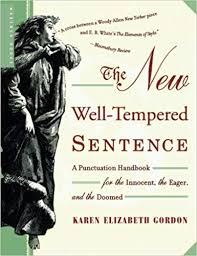
The title says it all really. The book is hugely entertaining; there is certainly nothing dry or dull about this. Struck & White is a quick and crisp reference book, but Karen Gordon’s offering has totally original explanations of the rules of grammar, together with witty and whimsical illustrations. It is even peopled by a small cast of characters, which you wouldn’t usually expect in a grammar book.
Get hold of a copy if you can. It’s a riveting read!
 So thoughtfully and wittily written, if you haven’t already come across it, I commend this book to you!







 luna's on line