“Souls cross the skies of time, like clouds crossing the skies of the world.” David Mitchell, Cloud Atlas.
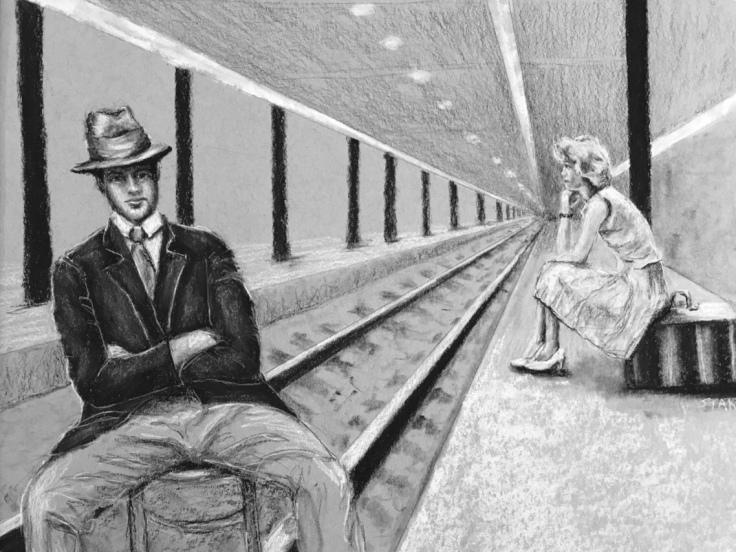
Charcoal drawing by Suzanne Starr
She sits and waits; a traveller. He sits, arms folded, staring into space where for him there is now only the present. Time stretches away. Infinite co-ordinates undefined. Souls slip past each other.
She stares at a wall, across tracks she cannot see; the tracks of time. The tracks of my tears. For I am that girl with no past and no future and I am waiting for you.
We agreed we’d meet, that we’d find each other. On the other side.
Before:
– Do you believe in reincarnation? – Maybe. – Do you think we come back as ghosts? – Perhaps. – If we do, shall we meet? – We’ll need to arrange where and when. – Each other’s birthdays? – Will you remember? – Of course. – Where then? – I don’t know. – We can decide later, there’s plenty of time.
I remember The Time Before. The time before The Changes, before the bees died all over the world. Suddenly. All wiped out. It was that one dreadful year when things started to break down. Lots of things happened, but it was all about the bees.
We knew they were important.
We knew they were vital.
We knew they were vital for life.
Everyone had predicted it would be a catastrophe; but it turned out there was hope. There was a work-around; people with technology, scientists, biologists, cyberneticists. They had a plan.
They brought out the drones. Not the only-good-for-one-thing males of the bee species. No, these were machines.
But we didn’t realise that these tiny robots were more than just little automated pollinators.
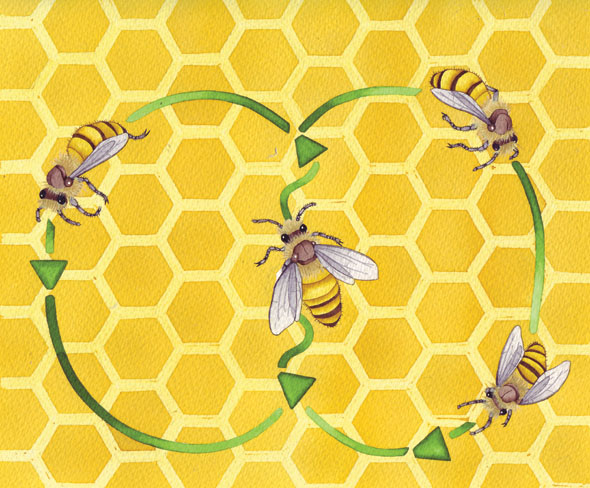
Did you know about the waggle dance? The one a bee did to tell other bees where to find the good stuff. No? Well it doesn’t matter. What does matter is that the new drones, the cute little bee drones, have eyes everywhere. They’re watching us. So you’d better toe the line.
They don’t do a dance, but they do tell their masters.
They watch; their masters observe.
Their masters control. Your life.
Everyone had predicted it would be a catastrophe, and it was. But not in the way people had thought. And now nothing is like it was in The Time Before.
My second cross-continental collaboration with artist, Suzanne Starr.
This story was inspired by Suzanne’s drawing which I saw on myLinkedInfeed. Once again, I found the images of her characters so compelling that I had to write their story.
‘That’s a pretty dress, Miss Clara,’ said the Stork, as the little girl approached him. ‘Oh, but you look sad on your birthday. Why?’ She is so tall now, he thought.
‘I wish I could just fly away like you do,’ Clara looked up at him with her large brown eyes.
‘What’s wrong, Miss Clara? You have a lovely home with people who care for you. Why are you unhappy?’
‘It’s just that I feel like I don’t belong properly. They’re not my people, are they?’ Clara fiddled with her lace-edged handkerchief. ‘You explained to me last year, you delivered me to the wrong people. I’ve been thinking about it all year.’
The Stork cocked his head and looked intently at her. ‘I know, Miss Clara, and I told you how sorry I am for my mistake.’
‘Did you tell the other little girl?’ Clara looked up at him, ‘the one who should’ve come here instead of me.’
The Stork hung his head, ‘no Miss Clara, I didn’t. And perhaps I shouldn’t have told you.’
‘So why did you?’ Clara was on the verge of tears. ‘Why did you, Stork?’
‘The two of you were my first deliveries and I got it wrong. That’s why I kept coming back to check on you, until you were old enough for me to talk to you and to explain properly.’
‘And the other little girl?’
The Stork shook his head sadly. ‘The mother realised something was wrong.’
‘My mother? My real mother?’
The Stork nodded.
‘What happened?’
The Stork’s beak drooped so that it almost touched the ground. ‘She thought the baby was a changeling.’
‘A changeling? What’s that?’
‘Some people believe that a changeling is a fairy child left in place of a human child which has been stolen by the fairies.
‘But it wasn’t a fairy child?’
‘No, of course not. That’s just a silly superstition.’
‘So what happened to her?’
‘She was left out on the hillside as is the custom in that part of our country.’
‘I don’t understand. Why would they do that?’
The Stork sighed. ‘They hope that the real baby will be returned.’
‘Oh.’ Clara was silent. She twisted her handkerchief some more. ‘But why didn’t you tell her? The mother, I mean.’
‘She could neither see me nor hear me.’ The Stork started to pace about. ‘Only little children can see and hear the Storks,’ he said over his shoulder.
‘And you couldn’t save the baby from the hillside?’
The Stork turned to face her. ‘She’d gone by the time I found out what had happened.’
Clara frowned. ‘Maybe the fairies did take her.’
‘I don’t believe in fairies.’
‘But maybe someone found her. Maybe she’s with another family?’
A large tear rolled down the Stork’s beak. ‘Don’t you think I looked for her; that day, the next day, the next week?’ The Stork sniffed and shook his huge dark head. ‘I searched for months and years, because of my mistake. That’s why you’ve been so precious to me.’
Clara went up to the Stork; she reached up and put her hand on his neck. ‘Poor Stork, I’m sorry.’
‘I will always be sorry, Miss Clara.’
Clara thought for a moment. ‘Can we go there and have a look?’ Clara waved her handkerchief towards the sky. ‘I’d love just to see where I might’ve been living.’
The Stork looked at her, eyes unblinking.
‘I could ride on your back,’ Clara ran her hand over the snowy feathers on his back. ‘It can’t be that far. If you mixed us up on the same night,’ she reasoned.
‘No, Miss Clara. It’s not possible.’
‘But Stork…’
‘I said no!’ He turned his back on her, hunching his wings.
Clara sat down on the edge of the sidewalk and started to cry.
The Stork couldn’t bear to hear her sobbing; he turned around and nudged her with his beak. ‘I’m sorry, Miss Clara, but I can’t.’
‘But it’s my birthday today.’
‘That’s the point, I’m afraid.’ The Stork folded his long legs underneath his white feathers and huddled close to her. ‘Today is the last day you will be able to see me or hear me. You see this is your tenth birthday, and after you pass the hour of your birth, you too will be blind and deaf to the Storks.’
Clara looked at him. The Stork looked up at the sun which was sinking below the tall buildings of the city. The soft feathers of his cheek brushed against Clara’s hair. ‘It’s almost time, little one.’ The Stork stood up, gently helping Clara to her feet with a brush of his long beak. The Stork faced her and bowed gracefully as the disc of the sun disappeared behind the dome of the cathedral.
Clara looked at him, wiping away her tears. ‘Stork, dear Stork…’ and as she spoke, his image started to fade, so only a faint outline remained. His voice echoed around the little square. ‘Goodbye, Miss Clara.’ Then his was gone.
That night Clara had a dream, a very vivid dream. A girl about her age was waving to her from a bright, sunny hillside somewhere. She looked just how Clara imagined a fairy might look and she was smiling. And every year after that on her birthday, Clara found a soft white feather on her pillow.
*’He’s Back’ is one of two works by Suzanne Starr which form part of the ‘Into Darkness Exhibition’ at the Norwich Art Center, Connecticut USA. The exhibition runs throughout October 2018
‘No more rides,’ said Humphrey the Unicorn, ‘especially not for that fat fairy.’ He was talking to himself, deep in the enchanted forest. His back ached and his horn was sore where the young fairies, pixies and elves had been touching it for luck. Much will that do them, he thought.
Humphrey sighed, ‘a noble beast like me, scratching a living as a side-show attraction at Friday’s Fantastical Fair. He wandered over to a patch of four-leaved clover and started munching.
‘Hey, Unicorn!’ said a voice. Humphrey looked up to see a strange little man leaning against a tree with a notebook in his hand and a pencil behind his ear.
‘You’re good at story-telling aren’t you?’ the little man said.
Humphrey nodded. He’d always been fond of telling stories, but the magical kids of today weren’t interested.
‘And you’re looking for a new career?’
Humphrey nodded again.
‘Okay, here’s the thing,’ the little man pulled the pencil from behind his ear and waved it with a flourish. ‘I’ll pay you double what you get from the Friday Fantastical Fair, if every week, without fail, you provide me with a 250 word story for my Friday Flash Fiction spot.’
Humphrey jumped at the chance. He and The Writer, for that was who the strange little man was, made a pact for life. But one year later, when Humphrey couldn’t squeeze his brain for even one more story, he found to his cost that he’d made a pact with the devil.
Inspired byThe Haunted Wordsmith’s Three Things Challenge– fairy, unicorn, devil These little prompts are coming to an end, but with Halloween approaching Teresa promises us new inspiration for tales of ghosties and ghoulies and long-legged beasties.
Sounds like fun!
When I saw this drawing by artist, Suzanne Starr, on my LinkedIn feed, I was so intrigued by the figures in the picture that I had to write their story. I contacted Suzanne to ask her permission, and now we have a collaboration across continents. Awesome!
‘Who are they, Ashley?’ Charlie pointed up at the picture on his bedroom wall. ‘Are they family too?’
Ashley glanced at the picture which was hanging next to the school room door. She’d never really noticed it before, but then she’d hardly ever been in the austere blue-painted room (formerly the nanny’s room) in which her young cousin was staying until it was time for him to start at his new school in England.
‘I don’t rightly know, Charlie.’ Ashley carefully took the picture down from the wall and came to sit beside him on the bed. They looked at it together. It was a small pencil drawing of five children of varying ages, or maybe four children and their mother, tightly grouped together with their arms wrapped around each other. They were wearing outdoor clothes which looked rather old-fashioned, thought Ashley. The drawing looked old too, faded, the paper discoloured along the one edge of the wooden frame.
‘Look at their expressions; they’re so lifelike.’ said Ashley.’
‘They look sad,’ said Charlie.
‘Maybe it’s because they’re posing,’ said Ashley. ‘Like the in the old photographs on the piano downstairs.’
‘The little boy at the front, what’s he holding?
Ashley peered at the picture. ‘I think it’s a spinning top. You know, you push the handle up and down,’ she demonstrated a pumping action, ‘and it spins. I’m sure we’ve still got ours somewhere. I’ll see if Hodge knows where it is.’
‘But I wonder why he looks so cross.’
‘Perhaps it’s because he’s had to stand still for so long and maybe he’d rather go and play,’ she ruffled Charlie’s golden hair. ‘You’d be scowling too.’ Ashley laughed.
Charlie pouted and then giggled as Ashley chucked him under the chin.
Ashley returned the picture to its place on the wall. ‘Come on, Charlie, it’s time for lunch. We can ask Hodge about the spinning top.’
***
Ashley was curled up in the drawing room with her notebook at her side. She’d intended to finish her latest fairy story, but her mind kept drifting back to the drawing. Maybe there was a story there, ‘The people who lived in the picture’. She smiled to herself and glanced at her watch; Charlie was supposed to be studying to prepare him for the start of school, but he wouldn’t mind if she just popped in to borrow the picture. As instructed, she wouldn’t disturb him.
Charlie’s door was closed. ‘Charlie? Can I come in?” Ashley knocked politely and waited. ‘Charlie? Are you there?
There was no reply. Ashley put her ear to the door. Perhaps he’d dozed off. She wouldn’t be surprised; the books with which he’d arrived looked deathly dull to her. As she put her hand on the doorknob, she heard a huge crash, as if something had fallen on the floor.
‘Charlie?’ She turned the doorknob and pushed the door, but it wouldn’t open. ‘Charlie! Let me in!’ She shoved the door hard and it yielded. She looked around. Charlie was crouching on the floor in the corner of the room. A brightly painted metal spinning top rolled across the room towards her.
Ashley picked the toy up and turned to Charlie. ‘Hodge found it then,’ she said. ‘What on earth were you doing with it?’
Charlie shook his head and pointed to the picture. Ashley crossed the room and looked; the little boy’s hands were empty. He was leaning forward, arms outstretched, as if he’d just dropped (thrown?) something. Ashley looked at Charlie in disbelief.
Ashley held out her hand to Charlie. They fled from the room.
They found Hodge peeling potatoes in the kitchen. Breathlessly Charlie tried to explain what had happened.
‘Slow down, slow down!’ She wiped her hands on her apron. ‘Now, Miss Ashley, you’ve not been scaring young Master Charlie with your fairy stories, have you?’
Hodge reached out and put her arm around Charlie’s shoulder. ‘All right, luvvy, let’s go and have a look.’
Charlie hung back as Hodge marched into his bedroom followed by Ashley. The picture lay face down on the floor and the schoolroom door was open. Hodge bent down and picked it up. Suddenly the schoolroom door was snatched shut. Hodge looked up. ‘Master Charlie?’
‘I’m here,’ said Charlie stepping into the room. Behind him they heard footsteps running along the landing.
Hodge turned the picture over. It was a drawing of an empty room.
Great Being Five was going to be in trouble. Big trouble. She had contravened the Non-Interference Protocol on one of the four inhabited planets she managed. She’d made the odd little tweak here and there over the planet’s long lifetime, all of which had gone unnoticed. But this time it was going to be obvious. As she saw it though, she’d had no alternative.
She’d never had any difficulty with her other three planets. Admittedly two of them were at such an early stage of development that there was really nothing to do but wait for something to happen. The third was a lovely, tranquil world, covered in lush vegetation and populated only by colourful birds which lived off fruits and seeds. She’d wrapped a subtle cloaking device around it in the hope of keeping it concealed from any advanced astral beings who, if they came upon it, would inevitably decide that it would make a nice second home. That would never do. So far none of the other Great Beings had noticed and her pretty planet had remained undiscovered.
Earth was an entirely different matter. Her little humans had really let the planet go. They had developed into such clever beings; so inventive! so creative! But so many of their inventions had had such a devastating impact on her lovely blue planet. Busily burning fossil fuels, chopping down trees, ruining the very soil they stood on. And then there was the killing. Each other mainly, but all those appealing animals they’d destroyed? Great Being Five was really mad about that.
The big issue was the planet itself. It really couldn’t cope for much longer. Great Being Five focused her third eye and scanned Planet Earth one more time. Swathes of empty forest all across the Amazon; huge scars left by the profligate plundering of mineral deposits which had developed over millennia; and the smog. Filthy air everywhere, a toxic sickly yellow; oceans clogged with seas of bobbing plastic; lakes and rivers coloured improbably by pollutants and algae blooms; fewer and fewer birds and animals. And all those people. People everywhere!
Great Being Five consulted the stats section of her data banks. For the past 40 years, the humans had been using more than double their annual quota of resources. There were other alarming figures too. The report finished with a verdict: ‘Unsustainable; self-destruction inevitable by Earth date, 2020.’
What had happened to the little humans? Why had they become so careless and greedy? They’d ruined everything. She couldn’t let them destroy her favourite planet. No! She wouldn’t let it happen.
Great Being Five scrolled through the little icons on her console and selected one. She took a deep breath and hit the delete key.
With apologies to the creators of Star Trek and Doctor Who
The doors to the holodeck swooshed closed. Ensign Marcus Bain felt a warm breeze ruffle his crew cut and the midday sun on his skin. Dressed in appropriate time-period leisurewear he plunged into the fairground crowd.
Garish colours, distorted sounds and the smell of fried food assaulted his senses. He checked the handful of notes and coins which had been issued to him with his slippery pale blue nylon outfit. There had been some orientation information on the pre-entry briefing screen, but he’d barely skimmed it in his impatience to visit late-twentieth century Earth.
He stared about at the crudely-made mechanical rides from which music blared and people screamed. The young ensign selected a ride at random and proffered a handful of coins. The operator raised his eyebrows and laughed, saying something Marcus didn’t catch, before showing him to one of the little rubber-rimmed cars which people were driving around the smooth oval-shaped rink.
Marcus had only just wedged himself into the seat of his little green car when someone bumped him hard from behind. He swivelled around, but the car had already reversed away. Then another slammed into him from the side. “You drive like a Klingon on Rackta,” he yelled at the driver who gave him a thumbs-up sign before driving off to bash a little blue car. Marcus clutched the steering wheel and depressed the single pedal on the floor. The car moved forward, describing a graceful arc.
He cruised around the rink, skilfully avoiding attempts by other cars to bump him. It was a bit like steering a star-ship through a meteor shower; not that he’d actually done that other than on a simulator. Marcus was oblivious to the hostile looks from the other drivers as he evaded their challenges and failed to make any contact himself. Then three cars came at him at once, one behind and two on either side, driving him edge of the rink. There was nowhere for his little green car to go. Marcus swung his car around to face them and stopped. He could feel the pressure from their cars push against his, which was tight up against the rim of the rink. The electric charges from the poles mounted on the back of the cars crackled brightly on the conductive mesh above their heads. The three guys scowled at Marcus. All were dressed in tight cut off t-shirts which revealed hostile-looking tattoos on their arms. He saw the man on his right crack his knuckles.
Marcus was up and out of the little green car before they had a chance to move. He hesitated for a few seconds, then seeing them hoist themselves out onto the busy rink and advance towards him, he set off at a run. The nylon fabric of his clothing slid unpleasantly over his skin as he looked around for somewhere to lose his pursuers.
Marcus noticed a door flapping open at the rear of one of the flimsy buildings. He dived through the door slamming it behind him. It was very dark. Marcus felt his way along a narrow corridor. His stomach knotted as he heard his pursuers enter behind him. Marcus groped his way along the passage until he found another door; he opened it cautiously and slipped through.
It was suddenly very bright; the walls around him were lined with mirrors which distorted and multiplied his reflection. He rounded a corner, hurrying past the grotesque versions of his reflected self into a mirror-lined corridor which twisted and zigzagged before opening into a large, triangular-shaped room. He heard a shout: ‘split up, get him.’ Heavy footsteps pounded on the wooden floor; the mirrors shook. Before Marcus could decide which way to run, three figures appeared each from a different doorway. Marcus was trapped.
‘Exit!’ shouted Marcus, remembering the escape command.
‘We’re not going anywhere,’ one of them grunted. The three men closed in on the now desperate Marcus, who knew he was not immune to blows from holographic foe.
‘Exit!’ Marcus yelled again. Why didn’t the program end?
Vworp! Vworp! The three men stopped and turned to see a large shape materializing in the middle of the room. Marcus sighed with relief. But what appeared wasn’t what he’d expected. Rather than an archway, it was a big blue box, taller than a man and a little wider than the double doors in the side which faced him. Perhaps this was a new version of the Arch? He wished he’d read the briefing more thoroughly. One of the doors opened and a figure in a long brown coat and an even longer stripy scarf appeared. He raised his broad-brimmed hat revealing a shock of unruly, curly hair.
‘Good afternoon, gentlemen,’ he said. He looked at Marcus, ‘You’d better come with me ensign.’
Marcus hesitated; his three would-be assailants stood open-mouthed.
‘Come along Ensign Bain, hurry up now,’ the man said, beckoning to him. ‘This way.’
Marcus hurried toward the blue box. ‘Who are you?’ he asked his rescuer as he drew level with him at the doorway.
‘I’m the Doctor,’ he replied, offering Marcus a toothy grin as he ushered him inside.
‘Doctor who?’ asked Marcus.
‘Have a jelly baby,’ said the Doctor, offering him a crumpled paper bag.
Marcus stared around him.
‘Welcome to the Tardis! Bigger on the inside, yes, I know,’ said the Doctor, beaming wide-eyed at Marcus. ‘Now let’s get you back where you belong,’ he said as he pushed buttons and pulled on levers at the central console.
Before Marcus could take stock of his surroundings, the Tardis materialized in the engine room of the USS Enterprise. ‘Home,’ said the Doctor, helping a dazed Marcus out.
‘Aye, another one, is it Doctor?’ said Scotty, the Chief Engineer.
The Doctor nodded. ‘Your virtual reality toy keeps causing a tiny rift in the space-time continuum. You need to fix it. I’ve better things to do than scoop up young ensigns on their day off.’
‘Aye, Doctor,’ said Scotty, ‘we’ll get onto it right away.’
Even for a Catholic Church there are a lot of statues. Not just the usual suspects: Our Lord on the Cross, Our Lady Weeping (touch of woodworm on those toes), and good old Saint Francis with a mouldy-looking bird on each hand and a rabbit missing half an ear at his feet. All have been subjected to some dodgy touch-up jobs. Nail varnish on Saint Anne? You shake your head.
There are newer statues too; peopling the perimeter like extras from a low-budget film. They stare out from the shadows, waiting for the action.
You drop a coin in the shabby wooden box, select a candle, light the wick and place it among its fellows. You pause, looking like you’re offering a prayer; for form’s sake.
You glance at your watch. Surely he should be here by now?
Perching on a pew near the back of the nave, you survey the altar. The altar cloth is rumpled and askew; the silverware huddled together at one end, as if something (someone?) had been resting there and was suddenly removed.
A shaft of sunlight falls on the golden lectern, illuminating the outstretched wings of the malformed eagle which support a heavy leather-bound bible on its wings. You notice a chain and padlock securing the stand to a ring-bolt in the floor. You can’t be too careful these days. Something catches your eye; movement reflected in the eagle’s wings. You glance over your shoulder. The statues appear closer; one of them, a young man, has a hand raised as if in greeting. Was it like that before?
The clouds move over the sun and the lectern fades in the gloom. A door scrapes open and a pool of yellow light spills onto the flagstones alongside the altar. There is a shadow too: an elongated arm with an extended finger touches the edge of the altar cloth. Then ghost-sounds of shuffling feet, whispers of words and the rasp of heavy breaths echo across the nave. You suddenly notice that the statues are lined up along the central aisle. They watch you; empty-eyed. How did they get there? You close your eyes, shake your head and open them again. Are you dreaming? You don’t think so.
A door slams somewhere and a black-garbed priest appears carrying violin case. The man for whom you’d been waiting: the one who says he has a story for you. He sets the case down on the altar and opens it, taking out a strange-looking rifle. He glances at the statues and stares back at you. Now he smiles and flicks off the safety catch.
They say you never hear the bullet which kills you. Father Anselm’s petrifying bullets are different.
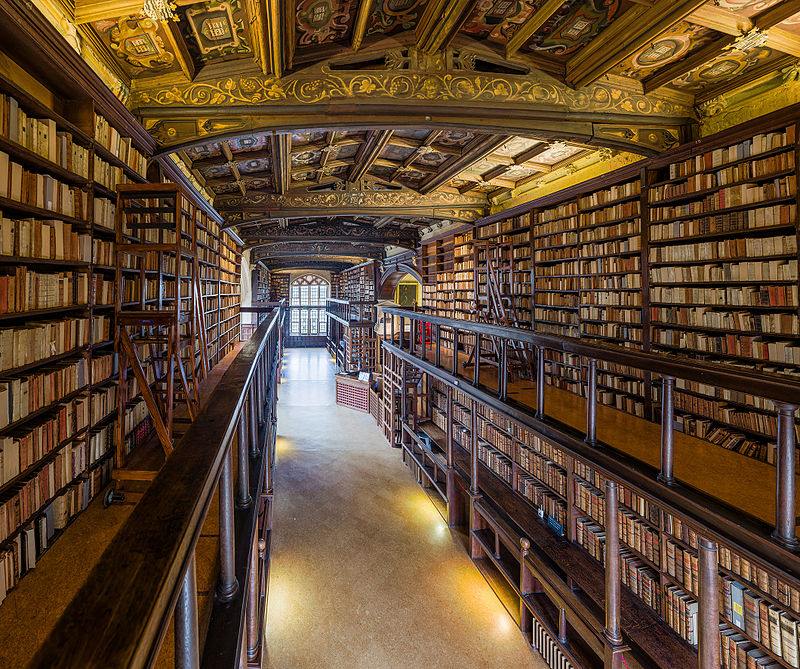
Duke Humfrey’s Library, the oldest reading room of the Bodleian Library, University of Oxford Photo by DAVID ILIFF. License: CC-BY-SA 3.0
She hadn’t realised the consequences of taking down that old book and reading from it aloud. Nobody had warned her.
She’d always loved books; especially old books. Battered and bruised, but still adorable. Like a comfortable old armchair. The feel of the paper, pages yellowed at the edges, curled like parchment, worn down by the gaze of its readers. The smell: a little musty; a little dusty. And words which have been read and re-read; taken in, digested.
She’d been permitted to browse this ancient library. To scale the heights of the upper shelves and plumb the depths of the bottom-most archives. To swim in an ocean of promised words.
Finally, she made her choice, a heavy tome and rather old. The pages were discoloured, their edges torn, and the leather binding scuffed and stained. But the drawings of flowers and birds it contained were still colourful. There were passages of script held within the pages, although the language and spelling were archaic and hard to follow.
She took her prize to a remote desk and opened it carefully. She pored over it; savouring it. The illustrations were remarkable; tinted drawings so precise that they could have been photographs: two young girls dressed in pinafores, chanting a hand clapping game. Over the next page, a robust woman in a heavy woollen dress shouting straight out of the page at her, brows knitted with concern, arms open in appeal. A little further on, a poem was it? To be read aloud; of course.
And as she whispered the words, the world grew very bright for a moment, and then the lights went out.
Come, gentle reader, open the book! Look, she’s waving at you; page 229.
The HQ of Deeply Underground Subversive Comics was under attack. Bullets sprayed across the hillside from a jet fighter. Moments later a nearby explosion rocked the desk where Mick was working.
“Dammit, we’re going to have to move out!” He yelled at Simone, who was steadying her laptop with one hand while furiously typing lines of complex coding with the other.
“Can you reconfigure the IP address before we go?” she yelled back.
“Sure, I’m on it.” Mick flung himself down at the adjacent desk and pulled the keyboard onto his lap. “What were you working on anyway?”
“Just some research for ‘Jasmine’s Day’.”
“Not on Google?”
“It was only innocent stuff,” replied Simone, emptying her desk drawer into a large canvas satchel.
“Huh, like last time.” Mick’s fingers danced over the keyboard. “Why can’t you just stay in the Deep Web?”
The flames outside were dying down. Suddenly the viewing screen was filled with what looked like giant flying insects. “Drones incoming!” Simone shouted as she crouched behind the main console and started to rummage about in a cupboard.
“Deploy ‘Flame Kitten’,” Mick turned to give the order to Jonesy.
“No can do boss, she’s busy in Syria.”
“Who else we got?” Mick finished typing and slung the keyboard back on the desk.
“‘Silver Sparrow’s in South Sudan and ‘Galactic Gecko’s in…”
“Dammit! What’s the point in us creating these superheroes if they’re not here for us when we need them?” Mick hammered his fist on the arm of his chair.
“Prime directive boss,” Jonesy shut down his screen with a click and tucked the tablet into his overalls.
There was another explosion and an ominous crack appeared in the ceiling. Simone looked up. “C’mon guys, we’ve got to get out! To the escape corridor!” She slung the satchel over her shoulder and pulled out her cell-phone. “There’s nothing for it,” she tapped the screen rapidly; “I’m messaging ‘Grand Trope Central’.”
“You’re doing what?!” Mick grabbed his rucksack from under the desk.
“We’re going to need something good if we’re going to get out of this.”
Mick, Simone and Jonesy reached the corridor just as the ceiling collapsed and the roof caved in. Flames shot across the room.
“Sealing hatch!” Simone announced as she hit a large red button mounted on the wall. A metal shutter slid into place closing off the corridor. “C’mon, run! It won’t hold for long.”
As they jogged along, their progress was hampered by a series of thick cords which crisscrossed the brightly lit passage. Mick grunted as he clambered through the knotted strands. “What the hell are these, anyway?”
“Twisted plotlines,” replied Simone. “Try to bend them rather than break them; they might be important.”
Simone’s cell-phone beeped, signalling an incoming message. At the same moment the corridor lights failed, plunging them into darkness. The only illumination was from the phone; the message read: ‘look ahead’. Simone looked up from her phone; a large wooden door had appeared from nowhere right in front of them, seemingly hanging in limbo. Golden light leaked around the edges of the door. A red neon sign flashed. ‘Enter,’ it commanded. Simone glanced at her two companions.
“What the f…” Mick took a step towards the door, as the excruciating sound of shearing metal echoed down the passage. They heard a drone whirring towards them.
“C’mon,” Simone tugged at the sleeve of Jonesy’s overalls, “we’ve no alternative.”
Mick touched the door which swung inwards, bathing them in the bright golden light. Blindly they rushed through; the door slammed shut behind them. Slowly their eyes adjusted. They looked around, confused. They were back in the room from where they’d just made their escape, but it was undamaged. Good as new.
The viewing screen over the main console flickered on to reveal a figure, features obscured by the bright back lighting.
“Sit down,” commanded the voice from the screen. Obediently Simone, Mick and Jonesy seated themselves at their workstations. “You have done well,” the voice continued, “but now you must move to the next level.” The walls around them began to shimmer. “Write yourselves out of this!” The screen dissolved. There was a loud pop and a flash of light.
“Whoa, what’s happening?” Mick‘s words were barely audible above the sound of rushing wind. Suddenly the noise stopped. They looked up at the viewing screen. Outside the view was as green and tranquil as before the recent attack.
Mick shrugged. “No immediate threat then?”
“Maybe not.” As Simone took out her laptop the sky darkened. On the viewing screen they saw a huge metal disc hovering over the mountain. It didn’t look friendly.
“Here we go again!” Mick said, snatching his keyboard from the desk.




 luna's on line