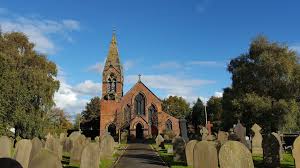
Location, Location, Location #3

Location No 3 – Preston, Lancashire

Preston, in the north west of England, is not the loveliest of towns, although it has some hidden gems. Too much 20th century development has trampled over the heart of the place, which dates back to Roman times. Preston came to prominence as far back as the 12th century, but the city’s history is not why this location is important to our literary journey today.

Once again, we’re delving into some of the background to The Silver Locket.

I was working in Lancashire County Council’s offices in Preston when I started writing the novel, and working in that public sector environment somehow led me to Laura’s occupation: a translator for the EU in Brussels (remember we’re back in 1989). It was my daily commute there from Liverpool through Rufford that really kick-started the novel. Driving fifty miles each way gives a writer lots of thinking time, in between listening to Radio 4, and I wrote many scenes in my head whilst on the road. Naturally, I couldn’t resist a little nod to the city in which I was working.

My desk at County Hall overlooked the Lancashire Records Office, which Laura visits to find out more about the family who lived in the house she’d inherited. It’s a strange building, elevated on stilts. I never did find out why. Nor did I actually visit the place. My knowledge of its operation came from a friend of mine, who was training as an archivist at the time. That’s Jo.

Real people, or sometimes just their names, do occasionally find themselves recreated fictionally in my books. The surname of the Reverend who married Cathy’s parents was borrowed from a colleague. He was rather pleased when I told him.

But back to our setting and the jeweller’s shop that Laura visits. Conveniently, there is (or at least was) a tiny jeweller’s shop, almost exactly as described in the book. Rather dark and mysterious, it had just the kind of owner who’d have the right connections to point Laura in the right direction to solve the mystery of her locket. More about where that takes her another time.

You’ll also notice I make references to the weather. Preston must be the wettest and windiest place I’ve ever encountered!

Excerpt from ‘The Silver Locket’

Twenty minutes later, the train pulled in at Preston. The station was larger and grander than Laura expected, with its curved wrought ironwork and glass roof supported on ornate columns which harked back the Victorian age of steam. From what Laura could see, Preston itself was rather less impressive than its railway station, although she was pleased to see a large Debenhams store on the corner. She might call in on the way back. Now she’d decided to stay on at the house for a while, she could do with a more extensive wardrobe than the suitcase-full she had brought.

Laura followed the directions given to her by the archivist she had spoken to at the Records Office on the phone the previous day. As she passed the solid square building of the county council offices, Laura imagined the staff inside scratching away at piles of bureaucracy, much like their counterparts in Brussels.

The Records Office was as described: an oblong building on stilts. Maybe the building was so strangely elevated to protect the records from flood, although despite the volume of the recent rain, it seemed unlikely that flood waters would ever reach such a height.

The archivist, Jo, who she’d spoken to on the phone, was an attractive young woman with long blonde hair. She was a great help, setting her up with the microfiche records of baptisms and burials from St. Mary’s church. Laura scanned through the records. It didn’t take her long to get used to navigating through the closely written text. Laura knew that the date of Cathy’s baptism had to before 1912. If Peter had been 22 when he’d died, as it said on the gravestone, he would have been born in 1890, just over a hundred years ago. Cathy was obviously his younger sister, so she should start looking at the entries after 1890.

And there it was: Catherine Emily Martland, baptised 31st March 1897. Her parents’ names, Thomas Edgar and Sarah Elizabeth, of Rufford, Lancashire. The ceremony performed by the Reverend Josiah Blackburn.

At last, here was the proof that Cathy had existed. This had to be the Cathy who experiences she had lived out in the two dreams, she’d had. Dreams that had been so vivid, it had been as if she was Cathy herself. Laura had never had dreams like these before. She wasn’t exactly disturbed by them, but it was strange. Maybe it was as Helen had said. She was just so immersed in the house that she was bound to dream about it. But still, why wasn’t she dreaming about her aunt? Why were the dreams taking her back to an earlier period in the house’s history?

Laura exchanged the baptisms sheet for the burials one. There was no record of the burials of Thomas or Peter. The woman in the churchyard had said that they never found Thomas’s body. Maybe Peter’s body had been lost too. Sarah’s burial was dated 18th July 1916.  She and Cathy had already moved out of the house, of course, as Lucy’s husband had purchased it in 1913. Laura wondered where they had gone. She continued to scan the records, but she could find no entry for Catherine. Her eyes were getting tired, and anyway she had found out what she really wanted to know. One final scan and her eyes found the name James Clayton, Lucy’s husband. He had died in 1925. Poor Lucy, though maybe if he had been so badly shell-shocked, it had been something of a relief.

Laura returned the microfiche sheets to their box and took them back to the counter.

“Any luck?” asked Jo.

“Yes, thanks,” Laura replied. “I found what I was looking for.”

“Well, if you need anything else, you know where we are.”

Laura headed back towards the station, passing the entrance and heading for the ugly Fishergate Centre which housed Debenhams. A quick coffee and a slice of cake fortified her for some proper retail therapy. Although not a particularly keen clothes shopper, Laura was happy enough browsing the displays and picking out some practical additions to her currently sparse wardrobe. She also splashed out on a duvet and a pretty cover, since she was missing the comfort and ease of a quilt, being no longer accustomed to the sheets and blankets she was using now.

As she left the Centre she noticed a small jeweller’s shop on the opposite corner. She still had the locket fastened around her neck and it would be the ideal opportunity to have it examined. The bell on the door rang loudly as she entered.

“Be right with you,” called a voice from the back room of the shop. Presently, a man emerged.

“Could you take a look at this for me?” Laura asked unfastening the ribbon and handing him the little necklace. “I think it should open, but I’m afraid of breaking it.”

He turned the locket over in his hand. “I’m a bit busy just now, but I can certainly look at it tomorrow if you want to leave it with me.”

Laura hesitated. Somehow she didn’t want to part with the locket. But that was stupid. She could easily come back on the train tomorrow. She nodded and took his card.

Fortunately the train wasn’t crowded and Laura was able to secure sufficient space to accommodate her purchases. As the train pulled into Rufford station, she recognised the woman in the brown coat again. She had just left the platform and was heading over the level crossing. Laura was keen to speak to her. She hurried off the train, dragging her carrier bags with her. The woman turned into the churchyard. Laura tried to quicken her pace, but the wind which had replaced the rain, caught the unwieldy bags and slowed her down. By the time she reached the church the woman had vanished. Maybe she had gone into the church? Laura went to look, but the door was locked.


The Silver Locket: available as a paperback, ebook and on KindleUnlimited

Image credit: visitpreston.com

Location, Location, Location #2

Location No. 2 – Alderley Edge, Cheshire

In the second of my series discussing the settings for my novels, come with me to Alderley Edge, in Cheshire, NW England.

“Alderley Edge is an abrupt and elevated ridge, formerly the site of a beacon, which bears the appearance of having been detached by some great convulsion of nature. … The sides are varied with cultivated land, wood and rock; and the entire mass presents a striking object to all the surrounding district over which it commands a most extensive prospect.” The History of the County Palatine and City of Chester, George Ormerod (1819).

This looming escarpment provides the backdrop to my third novel, ‘Following the Green Rabbit’, which I began writing during NaNoWriMo in 2018. By this time, I’d been living in South Africa for eight years, so I was drawing heavily on my carefully stored memories of the English countryside for the setting.

Alderley Edge still towers over a patchwork of fields and farmland and small villages. It has an ancient, timeless quality. I drove past it numerous times when making the journey home from North Wales to Liverpool, and I can still see it clearly in my mind’s eye: a massive stark shape hunched over the surrounding landscape, dark against the glowing afternoon sky. This, and the open countryside beyond, the wide Cheshire Plain, peppered with old villages that still hold the essence of the past, was the perfect setting for the novel.

This location also provided the setting for two of my favourite childhood novels, The Weirdstone of Brisingamen and its sequel, The Moon of Gomrath, written by British novelist, Alan Garner. Garner lived locally and the timeless quality of the place and the legends associated with it, inspired him too. It’s a place where anything might happen at any time in history.

The towering escarpment, presiding as it does over a flat, low-lying landscape, is a metaphor for the wicked Lord of the Manor in the novel, whose presence looms over the lives of the people who live in the village where my two plucky heroines find themselves.

Excerpt from ‘Following the Green Rabbit’

They stood up, wondering where to run. The sound of the hooves was getting louder. A horse snorted and they heard a man cry out.

“Quick. Behind the house.” Bryony grabbed her sister’s hand and they ran around the back of the damaged building.

Seconds later the clearing was full of stomping horses. The girls cowered under the window at the back of the house.

A man shouted. “Where did he go?” Another voice: “Search the buildings.”

Bethany gasped. Bryony held her tight. Over her shoulder she saw something moving in the bushes. A boy’s head appeared. His eyes were wide-open and startled-looking. He stared straight at Bryony, who froze, clinging on to her sister. Bryony was aware of more shouting at the front of the house. The men were arguing. She focused on the boy’s face. It was scratched and dirty, his hair was sticking out wildly from under his cap and his shirt was torn. He looked to left and right, then beckoned to her, nodding and mouthing words to her.

Bethany twisted around to see what Bryony was looking at. She gasped in surprise. The boy beckoned with greater urgency. At the front of the building the shouting stopped.

Then suddenly, they heard the order. “Find him! Spread out! He’s got to be here somewhere.” The voice was harsh and the accent strange to Bryony’s ears. She looked at Bethany and nodded. They scrabbled into the bushes and followed the boy as he disappeared deep into the undergrowth.

He moved rapidly and the girls struggled to keep up. But they did. The men’s shouts as they rode around the glade on their heavy-hoofed horses spurred them on. Low branches tugged at their hair and their clothes, while brambles scratched their bare legs. They stumbled over roots and crawled over logs for what seemed like ages. The boy glanced back a couple of times to check on their progress, but he didn’t slacken the pace. Finally they came to a steep bank where he stopped.

“Get ourselves over that,” he nodded at the bank, “they’ll not follow. A bit further on there’s a place where we can stop and talk.”

The girls weren’t used to climbing but he showed them how to use the tree roots as hand and foot holds and they soon managed to clamber up. A series of rocky outcrops on the other side made it easy enough for the girls to scramble down.

“Follow me,” the boy said. The girls obeyed, picking their way along the rock-strewn path. Both were grateful to still be wearing their sturdy outdoor shoes from their morning walk into the village. A little further along he stopped again and led them down another dip in the land to a wide flat slab of stone at the entrance to a cave.

The boy flopped down on the ground just inside the cave. The girls followed his example, leaning back against the smooth cave walls. “That was a close call,” he said. “I thought me goose was well and truly cooked.”


This week the ebook is on special offer at 99c (USA, CAN, AUS), 99p (UK), R18.99 (RSA), and other local equivalents.

USA – http://ow.ly/vjAA50BItEj
UK – http://ow.ly/2IYA50BItEg
CAN – http://ow.ly/DBTL50BItEh
AUS – http://ow.ly/AZ7v50BItEk
Elsewhere – http://ow.ly/5vtd50BItEi

Image credit: Brian Abbott

Location, Location, Location #1

Location No. 1 – St Mary’s Church, Rufford

Come on a journey with me…

The setting is very important to a novel: the sense of place, time and social environment contextualizes the story so that the reader can visualize and experience it.

I thought it might be fun over the coming weeks for us to go and visit some of the places where my novels have been set. Each time I’ll give you a little of the background as why these locations were important to my story and important to me, and you can read how they fit into the narrative of the book.

We’ll begin in Rufford, a little village in West Lancashire, England, where my debut novel, The Silver Locket, is mainly set.

My route to work each day took me through this pretty little place with its traditional houses, surrounded by flat, fertile farmland. In the evening, I’d see a hawk hovering over a field, then swooping down to catch its prey, and through the early morning mist, a bright barn owl would fly low across the road, almost touching the windscreen.

Near the centre of the village, there is a big, brick-built Victorian house, set back from the road, in large grounds. I was particularly drawn to the huge old oak tree in the garden. It grew in my imagination and over time, the house and garden became the perfect location for my heroine, Laura, to begin her ‘journey’ through the pages of my story.

Early on in the book, Laura visits St. Mary’s, the local church in Rufford. Here, in the churchyard, we learn some important clues about the past inhabitants of the house that Laura has recently inherited, and we meet a new character, about whom there is a definite air of mystery.

St. Mary’s Church, Rufford, is a real place, although its resemblance to the church and churchyard in my story is no more than a passing one. However, I do share Laura’s passion for visiting old graveyards…

Excerpt from ‘The Silver Locket’

Laura was keen to explore some more of the village. She walked down the twisting side road towards St Mary’s Church. Laura had always loved old graveyards; there was something about the hint of past lives engraved on old lichen-covered gravestones which she found curiously satisfying. As Laura worked her way through the headstones reading names and dates it occurred to her that the inhabitants of Rufford had been a particularly hardy bunch, all living to a ripe old age over the last couple of centuries.

One grave stood out to contradict this. It belonged to the Martland family. She leant forward and read the inscription: ‘In memoriam: Peter, beloved son of Thomas and Sarah, aged 22 years, died in a storm off the New Hampshire coast, 28th April 1912.

Then beneath that: ‘Captain Thomas Edgar Martland, aged 49 years, lost with his ship “Ariadne” and all her crew, 14th April 1913.’ There was a poem:

‘Safely moored amongst the peaceful dead
And from his labours rests his weary head,
With Neptune’s waves many times he’s fought,
Yet the blow was struck when least was thought.’

and underneath that…

‘Rest in peace: Sarah, loving wife and mother, died of a broken heart, 15th July 1916, aged 45 years.”

“So sad,” someone said softly behind her.

Laura started. She hadn’t heard anyone approach. She turned to see a big, powerful-looking woman with thick greying hair drawn up into a bun. She wore a brown coat and sturdy-looking shoes.

“Sorry. I didn’t mean to startle you.” She spoke with a trace of an Irish lilt in her voice. “So sad, both Peter and the Captain gone and Peter’s first time at sea too.”

“They died within almost a year of each other,” said Laura, looking at the dates.

“That’s right. Peter was on his way back from his first trip to New York and the Captain, he was lost at almost the same time the following year. His poor body was never found. Mrs Martland was never the same again, losing them both… and then…” her voice trailed off. The woman shook her head, gazing beyond the gravestone into the distance. “Sad, so sad…”

“You remember them?” But how could she, thought Laura. The captain and his son had perished 75 years ago. “No, surely it was too long ago?”

The woman smiled back her, her expression far away.

“Do you live round here?” asked Laura. “I’ve just moved into my aunt’s old house in the village.”

“So you have,” said the woman in agreement.

Laura looked at her, wondering how she knew. News travelled fast in a small place like this she supposed. Memories too, would be in the psyche of the village.

“It was my home once.” the woman replied. She reached inside her coat and consulted a small silver fob watch which was pinned to her dress.  “I must go now.” She turned abruptly and walked away, her upright figure disappearing behind the west wall of the church.


The Silver Locket: available as a paperback, ebook and on KindleUnlimited