I’m a huge fan of David Mitchell’s novels; I just love his writing. Then I came upon this article in The New Yorker. It fascinated me, particularly since I’ve been trying to sketch a map of the (only partly fictional) tunnels which run under the city of Liverpool to help in the process of writing my current novel.
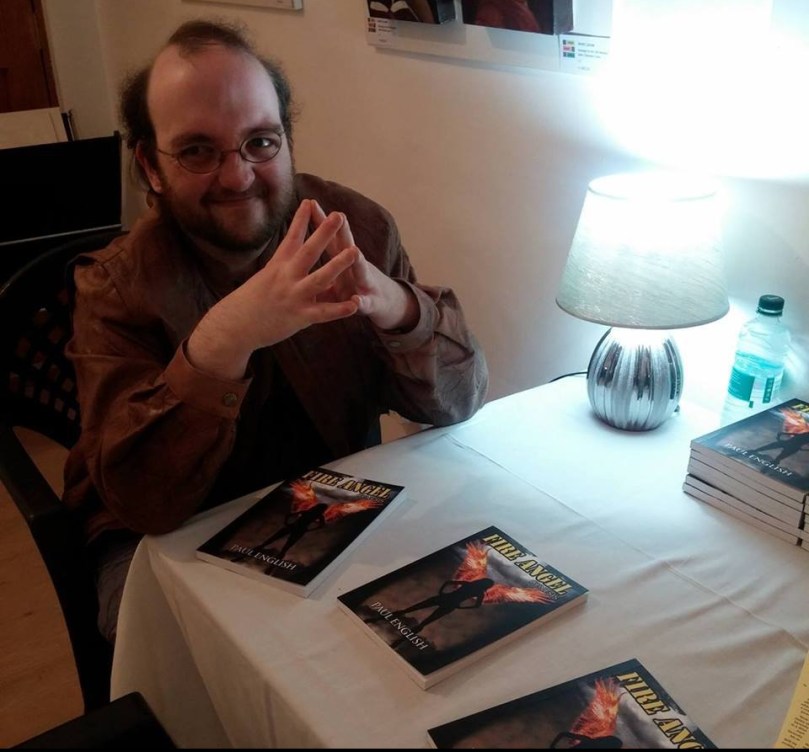
My writing buddy, Paul English, with whom I regularly meet for coffee to chat about our writing, recently published the second novel in his Superhero series. We’ve many times discussed how difficult it is to do one’s own publicity, but doing for someone else is much easier. The article will appear in the school magazine, and I shall be submitting it to our local paper.
New Superhero Books for School Library
Somerset West author, Paul English, has a new audience for his superhero novels. The first two books published in Paul’s Fire Angel Universe Series, ‘Fire Angel: Genesis’ and ‘Fire Angel: Turning Point’, have now been donated to the library of the International School of Cape Town by Cliff Davies, Head of Geography, who won them in an on-line competition run by the author through his Facebook fan page: https://www.facebook.com/FireAngelUniverse
Paul English at a book signing of his debut novel, ‘Fire Angel: Genesis’
Although you wouldn’t think it when you read his books, Paul has faced many difficult physical challenges in his life. The unexplained and undiagnosed syndrome with which he was born has affected both his sight and hearing throughout his 38 years. Nor has he an academic background, having left school after Grade 9. Paul says he found school boring as he felt it kept him from his drawing and writing!
The children’s TV series ‘Transformers’ first awoke the desire to write when Paul was just seven years old. Putting together his combined talent for writing and drawing, he has produced dozens of hand drawn comic books over the years.
Later the inspiration to create his own Superhero came from listening to an interview with Stan Lee about how he came up with Spider-Man and the Marvel Universe. After a few attempts to start his novel, Paul took a course in Creative Writing, which gave him a much better foundation. He regrets not having done that first of all and earnestly recommends this to aspiring writers.
Paul did not want to copy the stereotypical male hero with a perfect body and all the techno gadgets. His Superhero is Haley, a sassy but kind-hearted teenager living in a crime ridden working class neighbourhood, with fears of retrenchment looming over her parents.
In Paul’s first novel, ‘Fire Angel: Genesis’, Haley caught in the impact of a crashing meteorite which gives her some very unusual powers. Soon she is being hounded by unscrupulous people who want to harness her superpowers for themselves. Haley quickly learns not to trust anyone, especially not the scientists who have their own secret agenda.
In the sequel, ‘Fire Angel: Turning Point’, we meet a new superhuman, ‘Nemesis’, who brings death and destruction to all who have wronged her. A confrontation with her leads Haley down the dark path which she has set on. Haley faces some tough choices about whether she will return to defend her community or not.
Paul admits that there is a bit of him in Haley: courage in the face of difficulties, played down by a quirky sense of humour. Asked what his message to fellow writers would be, Paul says: ‘write the story you’d want to read.’
If you’d like your very own copies, ‘Fire Angel: Genesis’ and ‘Fire Angel: Turning Point’ are available as a double pack directly from Paul, priced at R270,00.
The third book in the series, ‘Fade’, will be published soon. The fourth novel is well underway and Paul has already come up with several more ideas for future books in the series.
There is one indispensable step to writing, and that is that you must sit down and write.
This is technically untrue, and was not such a hard and fast rule in the ancient days: Homer, said to be blind, would have been functionally illiterate; he worked the great epics in his head and presented them to live audiences. What we have now are versions likely written down by scribes taking dictation.
‘Roget’ by Thomas Pettigrew 1842, print of portrait, Medical Portrait Gallery
ROGET’S THESAURUS
Not a rare type of dinosaur, this wonderful list of vocabulary on a large scale, categorized by topics has earned an enduring reputation as a handy aid to composition. Nouns, verbs and adjectives are all widely represented, although not the dreaded adverb.
Roget’s Thesaurus was born out of need. As a young and busy doctor, who was much given to lecturing, Peter Mark Roget felt the need to improve his powers of expression.
A compulsive list-maker from the age of eight, Roget devised a ‘classed catalogue of words’ for his own use in 1805. However, it was not until he was in his seventies in 1852, that the first edition, called the ‘Thesaurus of English Words and Phrases Classified and Arranged so as to Facilitate the Expression of Ideas and Assist in Literary Composition’ was printed.
Roget’s life was marked by several depressing incidents. His father and his wife both died young; while his beloved maternal uncle committed suicide in his presence. Roget struggled with depression for most of his life. It is believed that his work on the thesaurus arose partly from an effort to battle it.
My battered old friend
Roget’s Thesaurus has been reprinted and revised many times since its original publication. My copy, a school prize no less, was the ‘New Edition, Completely Modernized and Abridged by Robert A. Dutch, and was hot off the press when I received it at the end my first year of high school in 1975. Doesn’t that date me!
I do still use my Roget from time to time. Okay, I know that Microsoft Office has its own in-built Thesaurus which can be handy, but it’s not anyway near as rich in vocabulary as Roget. Nor can you hold it in your hands and browse from section to section, as one intriguing word either spotted or remembered, takes you on a magical mystery tour for another.
I have to approach him with a degree of respect though, as my poor old paperback copy is rather delicate now, with loose pages and whole sections coming adrift at the seams. I hope I’ve worn a little better over these past 40-odd years.
But I wouldn’t be without him, my reliable old friend, Roget.
Good article. I’ve also found that commenting and helping to edit other people’s writing has made me more conscious of the way I write. There are some good examples of ‘tightening’ up too.
If you want to become a better writer, become a better editor.
If you want to become a better editor, edit work that is not your own.
I recently joined a local writers’ group and was requested to comment on various extracts from group members completed and in-progress work. I quickly found a number of recommendations I could make for improvement, but what came as a bit of a surprise, was when I went back and started editing some of my own work, I found exactly the same things there. One common mistake is using names too frequently when a pronoun would suffice.
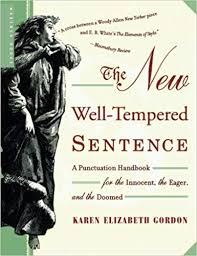
The title says it all really. The book is hugely entertaining; there is certainly nothing dry or dull about this. Struck & White is a quick and crisp reference book, but Karen Gordon’s offering has totally original explanations of the rules of grammar, together with witty and whimsical illustrations. It is even peopled by a small cast of characters, which you wouldn’t usually expect in a grammar book.
Get hold of a copy if you can. It’s a riveting read!
Some time ago I started dropping in on First Friday to meet and greet a few new bloggers. A lot of them are just learning the ropes and open to a little guidance, so I often leave some advice about categories and tags. I’m posting this here today in case these thoughts may help some other newbies and maybe some longtime bloggers who haven’t attached much importance to this angle.
Categories & Tags
…are very useful creatures. You can create them as you publish each post, using the sidebar on the right. Tagging our posts is how we invite other bloggers to check out what we’ve written. For example, if I create a Personal, or an Education, category or tag for my post, it will send my post title and a couple of lines to the Reader. Other bloggers searching for posts on Personal or Education will see mine listed…
Do have a look at this post! Nicole makes some great points.
I’ve become an avid reviewer on Goodreads and totally agree that being positive about another person’s work is important. As a writer, I guess you just have to take reviews on the chin, as with anyone who puts their work out there. I have some experience of the other side of this having worked as a curator in an art gallery. It’s never easy rejecting people’s submissions.
If you want to strike fear into the heart of any author, sidle up alongside them at a party and whisper, “Goodreeeeadsssss” in their ear.
For the uninitiated, Goodreads is a platform where readers rate books and recommend them to other readers—readers being the key word. Goodreads was never intended for authors, yet authors can’t resist snooping around in there. On rare occasions, the end result is a burst of pride, but more often than not, the author slinks away with a bruised ego—or rather, the wise author slinks away with a bruised ego; the Devil-may-care ones roll up their sleeves and fight.
Insider tip: this fighting from an author on behalf of her book? It’s not a good look. Not under any circumstances. Nope. Never. Sorry. Even if the reader is totally wrong about the novel you’ve devoted 10 years…
Let me start this off by saying plagiarists are the WORST.
Unfortunately, plagiarism is made easier than ever with self-publishing these days. If you post your work online – on fanfic forums, on Wattpad, on critique sites, on your own website, etc. – you run the risk of that work being stolen and put up for sale as an ebook, with someone else potentially making money off of your labour.
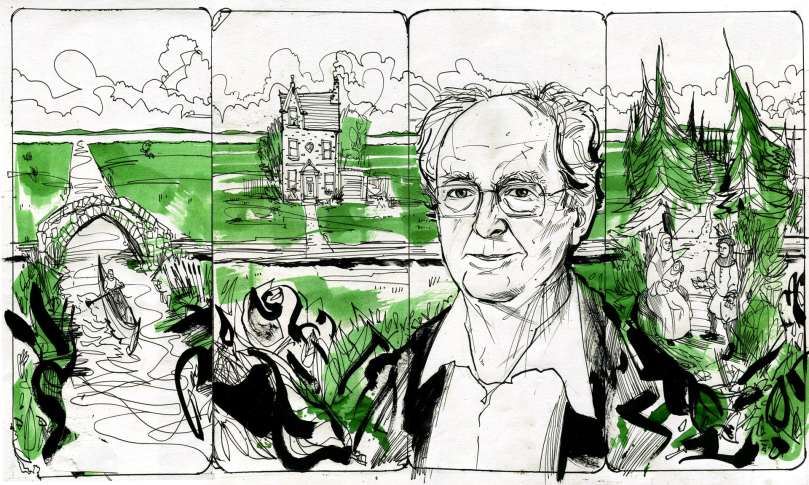
I came across this article written by the wonderful author, Philip Pullman. I found it very entertaining. It’s mostly about his writing space. Interesting. What’s yours like?
Courtesy of Guardian News & Media Ltd
Philip Pullman: ‘I use coloured pencils to show which key I’m writing in – D minor, at the moment’
The author on the importance of desk height, watching birds and Myriorama cards
I get to my desk (in a very small room at the top of the house) at about 10, and fiddle about with the height of the desk and the chair until I’m comfortable. I have a desk that I can raise or lower according to the state of my aching back. Sometimes I stand at it, and sometimes I have it high up to write at, and sometimes a bit lower to type.
The desk is covered by an ancient kilim, because it looks nice, but that’s not a good surface to write on, so I have one of those green safety cutting mats to support the paper I use, which is A4 narrow lined, with two holes. I love the shape of the A paper sizes. It’s the only one ofAndrea Palladio’s recommended architectural shapes (the ratios of room length to width, and so on) that contains an irrational number, in this case the ratio of one to the square root of two. Very handy for illustratingPythagoras’s famous theorem, in fact.
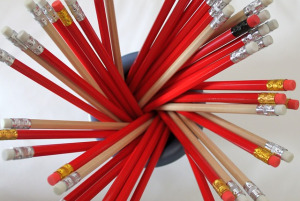
Nearby is a basket full of coloured pencils, including some of the best of all, the Berol Karisma range, now unfortunately discontinued. For each book I write, the paper is authorised for writing on by means of a coloured stripe along the top edge. I fan the sheets out and colour a stack at a time. The current book is a warm blend of Karisma Pumpkin Orange and Faber Castell Venetian Red. I sometimes think I should make it clear which key I’m writing a particular passage in – D minor, at the moment – but that would be silly, unlike colouring the pages, which makes perfect sense.







 “Seen that last review yet?”
 luna's on line