brazen beauty strutting on the stage taunting, teasing, technicolour dreams reaching for the bright lights looking for the wrong types see me, touch me, feel me take me, make me yours
drenched in glitz and glamour splayed legs go on forever shiny skin, huge black eyes lips that shine and pout beat thumping, heart racing she can never give enough
falling, sprawling every night another bed white lines, liquid gold rolling in the sultry dark waking, shaking dress torn and lipstick smeared
it happened once too often
star winked out
peel her from your wall fold her up and put her in your pocket.
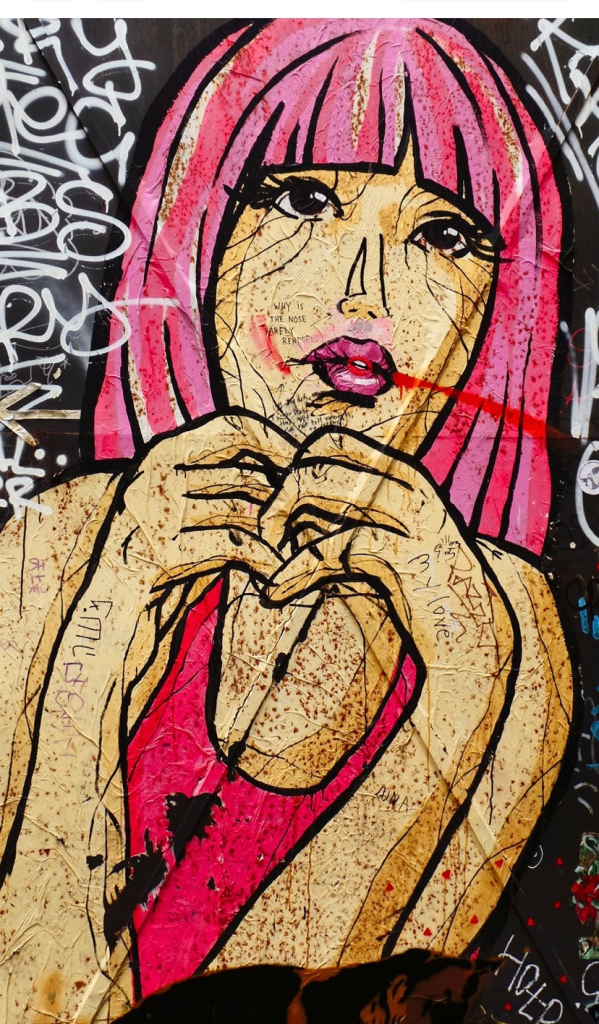
Image credit:Sean Robertson @Unsplash The image shows a painting of a woman on a wall. There are words scribbled on the sides of the wall art and people have drawn on the face too.
Lovely, isn’t it? This sampler, inherited from my husband’s side of the family, is by far the oldest piece we have in our house. We don’t know much about the family members mentioned, only that they were part of the Dodding family who were prosperous merchants living in the Lake District, in the north-west of England. The family made a fortune and built a fancy house then a risky investment in a coal mine in Birmingham, which turned out to have no mineable coal, led them to lose most of their money. The fancy house had to be sold, but that’s about all I know of their story. One thing I do know is that ‘our’ Elizabeth wasn’t related to the much more famous Elizabeth Gaskell, English novelist, biographer and short story writer, although that would have been so cool – a famous writer in the family!
But that’s not the reason I’m sharing this particular family heirloom with you. It’s because it is a ‘little inspiration’.
I was pondering on what to post today, wandering about the house (as I do), when I found myself contemplating the sampler. As I stood before the sampler my thoughts drifted to a recent post by Jean Lee on ‘How do you name your characters.’ My response to this question, about which she expands so interestingly, was this: ‘Naming characters is like naming cats… I have to wait for them to whisper them to me.’
Then I remembered that it was while I was gazing at the sampler that William, from Following the Green Rabbit, whispered his name to me. The date is about right for the ‘olden times’ part of the story, and it’s a nice ‘solid’ name for his character. I’d already named his wife, Ellen, for my maternal grandmother. The name just seemed right, and it was she who inspired me to improve my cookery skills. Grandma Atkins gave me her recipe for Lancashire Hotpot which in turn became my first published piece anywhere!
Grandma Atkins’s Lancashire Hotpot recipe, published in the Sunday Times!
And the ‘little inspiration’ for Ellen showing Bethany how to card wool in the excerpt below? Well, that came from my former life in the 17th century.
So now, what better time to introduce you to William, as my young heroine Bethany first finds herself back in the ‘olden times’.
.
Excerpt from Following the Green Rabbit
“There was this man. He was dressed oddly, in sort of sacking stuff, but he had a nice, friendly face and I wasn’t afraid. He reminded me of Papa in a way, you know how his eyes pucker up at the edges when he smiles?” Bethany fell silent.
Bryony looked out across the garden; she blinked quickly then turned back to her sister. “A man, you say, in the woods? What did you do?” She glanced towards the kitchen door and over to Tom’s work shed, but there was no sign of either of their benevolent and hugely protective guardians.
“Well, he held out his hand to me, and I took it. He said something, but I didn’t quite understand him. He had a funny way of talking.”
Bryony’s eyes widened. “You took his hand? Beth…”
“I know I shouldn’t’ve done, but…” Bethany closed her eyes and shook her hands in front of her, like she did when she knew she’d done something wrong.
Bryony stretched out and grabbed her hands. “It’s all right; gently now. Take a deep breath and tell me.”
Bethany breathed in and out a few times.
“That’s better. Pray continue,” said Bryony, imitating the voice of the frightful Miss C.
Bethany looked up. “He told me his name was William and he lived with his wife nearby. We walked a little way and we came to his house. It was built out of stones and had a sort of straw roof, like one of the ones from the olden days in our big history book, except it seemed quite new. There was another little building too, like Tom’s workshop, and there were chickens running about outside.”
“His wife was called Ellen and she was sitting on a little bench outside the house. She had a big mound of white fluffy stuff next to her. She said it was from one of their sheep and she showed me how she was straightening it out with two big brushes.” Bethany frowned, putting her head on one side. “What did she call it?” She looked up at the sky. “Carding, that’s it. It was called carding. She showed me how to do it. Then we went into the house and she gave me some milk and biscuits.”
“Then Ellen said it was getting late. She and William looked at each other, you know, that funny kind of look which adults give each other, when we’re not supposed to understand something.” Bethany rolled her eyes. “Then William said that he’d walk me back to the village, so I explained that we didn’t live in the village. And they gave each other that look again. So I told them where we lived, but they didn’t know our house. They said there was no big house over the other side of the wood; just more trees.”
Bryony frowned. ‘How could they not know Bluebell Wood House?”
Bethany shrugged. “Perhaps I didn’t explain it very well. You know I get muddled up with directions. Anyway, they asked me to stay where I was and they went outside for a little while. When they came back they looked happy again. William said he’d take me back to the part of the woods where he first saw me and I’d be sure to find my way home. So that’s what we did.”
“I hope you thanked Ellen.”
“Yes,” Bethany rolled her eyes again. “You sound just like Hodge.”
“Who’s taking my name in vain?”
The two girls looked round. Hodge was carrying a basket of washing to hang out on the line.
“Oh, nothing. We were just saying we should thank you for our lunch,” said Bryony quickly.
“Well, you’re very welcome and you can show me your gratitude by clearing the table there.” She balanced the washing basket on her hip and picked the little carved robin up from the table. “That’s a pretty little thing, so it is. Where did you get it?”
‘I found it in the w… orchard,” stammered Bethany.
‘Hmm,” Hodge pursed her lips and put it down. She shifted the heavy basket in front of her. “Just mind you carry those lunch things in carefully,” she said turning away and continuing down the garden.
They started to clear the table. When Hodge was out of earshot Bethany picked up the robin and turned to her sister. “When William took me back to the woods he gave this to me and said it was a present to remember him and Ellen by. I took it from him and looked at it, but then when I looked up he’d gone. I didn’t even get the chance to thank him.” She stroked the little carving. “The funny thing is that when he gave it to me it looked like new. The colours were all bright and shiny. Now it looks as if it’s really old.”
~~~~~~~~~~~~~~~~~~~~~~~~~~~~~~~~~~~~~~~
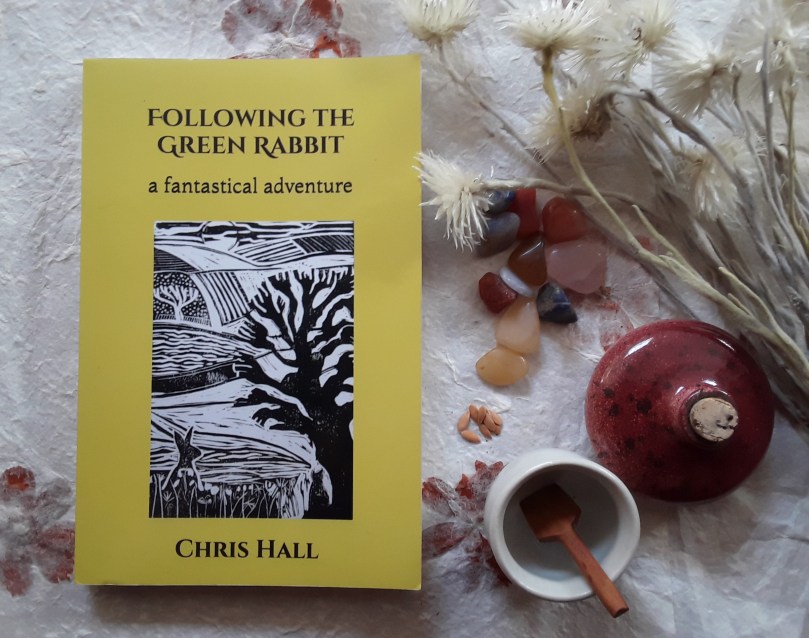
FOLLOWING THE GREEN RABBIT ~ a fantastical adventure
You finger the neatly folded garments which you’ve been instructed to put on; slippery to the touch and with a rainbowlike sheen, they are both inviting and intimidating; they are not the kind of clothing you are accustomed to wear but, without even asking yourself why, you dress in the unfamiliar items: underwear, bodysuit, socks and slippers, subconsciously yielding to yet another level of disassociation.
A vague feeling of contentment enfolds you and you cross to the window to observe your surroundings, surprised to find yourself on an upper floor, when you’re quite certain, so far as you can be, that you haven’t climbed a staircase or entered an elevator since you tumbled through the front entrance to… where?
The view overlooks an atrium enclosed on all four sides by lofty blank-windowed blocks, stretching up to graze a surprisingly bright blue and cloudless sky; the ground below is covered with the greenest grass you’ve ever seen: surely it must be synthetic? You study the featureless buildings, but no faces return your gaze.
You move across the room and slide open the bathroom door; there’s nothing remarkable here, although you notice there is no means of locking the door which you find vaguely disquieting but not, you assure yourself, any cause for alarm.
You return to the bed and lie down, your eyes roving over the ceiling and into the corners of the walls; spotting a pinprick of dull red light, you suppress a cry – a camera – you are being observed.
Confused? You might be! Read the first episode of The Facilityhere.
White-out world cold and stark bleak as the day you went away alone in the dark heart beating soul freezing night closes in no-one to love no-one to hold without you everything comes to a halt please will you throw me a rope.
It’s my great pleasure to welcome Paul English to this month’s Launch Pad spot!
Paul lives just up the road from me in Somerset West in the beautiful Western Cape of South Africa. You might remember him from the book signing we co-hosted back in 2019. It’s such a pleasure to have a fellow author close by with whom to exchange ideas and discuss the ups and downs of a writer’s life, although much of this has had to be virtual over the past year or so of lockdowns.
Paul’s an ardent superhero and sci-fi fan and has a love for mysteries, all of which has contributed to the writing of his novels. Originally inspired to create his first superhero character by watching an interview with the late great Stan Lee, Paul is an encyclopaedia of knowledge concerning anything and everything related to Marvel and DC comics. Paul’s also a keen follower of pro-wrestling and enjoys dabbling in drawing his own comic books and writing the stories. You can find him blogging about his writing and his books on his blog, Backroom Bulletin.
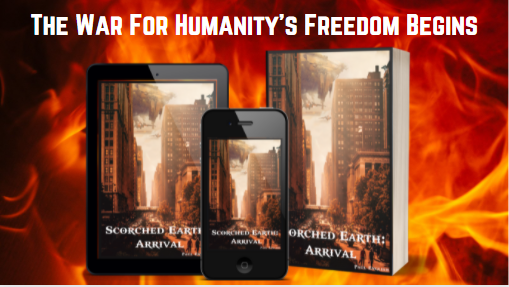
Paul’s book, Scorched Earth: Arrival was released earlier this year and he’s here to tell us about it. Take it away, Paul!
~~~
Thank you for having me on your blog today Chris, I’m excited to tell you about my latest book which is the start of my Scorched Earth trilogy.
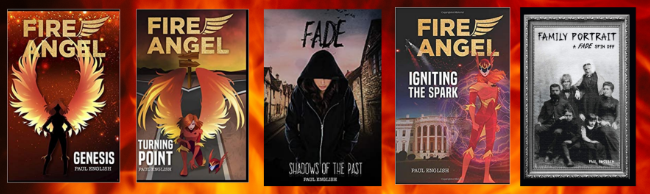
Scorched Earth: Arrival is the seventh book in the Fire Angel Universe, the new superhero universe which I created when I started my writing and publishing journey. Once I’d introduced several compelling characters over the course of my previous Fire Angel books, I decided it was time for all these characters to come together, and what better time for superheroes to meet than during an invasion from an alien empire? Given the fact I’m a science fiction fan it seemed the obvious choice and hence the Scorched Earth trilogy came into being. This first book deals with the arrival of a powerful alien force, an empire bent on the invasion of yet another planet: Earth.
Writing the Fire Angel series has been really enjoyable, although each book has come with its own set of challenges. The Scorched Earth trilogy is proving no different. I’m currently nearing the completion of the second book, Scorched Earth: Takeover, so keep an eye out for that when it comes out.
The Blurb
The Earth is being invaded. A hero falls.
As a ruthless alien empire sets its sights on Earth, the time has come for courageous people to step up and defend the world.
When Project: Guardian’s leader, Kat Palmer goes AWOL, Randy Wilson is next in line to lead the clandestine government task force against the most serious threat the human race has ever faced.
And now, when both the military and the police have their backs against the wall, humanity needs new heroes too. Alexandra Grant answers the call, not only to save others, but to redeem herself for condemning the superhuman, Fire Angel.
Meanwhile, the members of the underground Society of Science, are working against the clock to find a chink in the invaders’ armor and stop them before it’s too late.
‘Welcome to the…’ the double doors swish open before you can read the rest of the sign emblazoned across them and you stumble forward onto a deep coir doormat where a homely-looking nurse in a crisp white uniform stands waiting, clipboard in hand.
‘You must sign in,’ she says, taking you firmly by the elbow and propelling you towards a large wooden desk where an unsmiling administrator slides a sheet of paper across the polished surface towards you; the nurse thrusts a pen into your hand and for a moment you’re not sure what to do; you stare at the form but the words slide off the page and tumble into oblivion.
‘Just sign it, we have your details,’ instructs the unsmiling administrator; the homely-looking nurse stabs the form with a forefinger, so you submit a faint fragile scribble that seems to satisfy them.
The nurse whisks the pen from your fingers and indicates that you should follow her down a blank corridor lined with unlabelled doors, offering no clue as to what might lie behind them; you have no alternative than to comply, although you have no idea where you are or why you are here, so you shuffle along after her until finally she comes to a halt and opens a door.
She ushers you into a clean, compact dorm room: ‘Your new clothes are on the bed,’ she gives you a little shove then withdraws.
The key turns in the lock and her footsteps fade into silence.
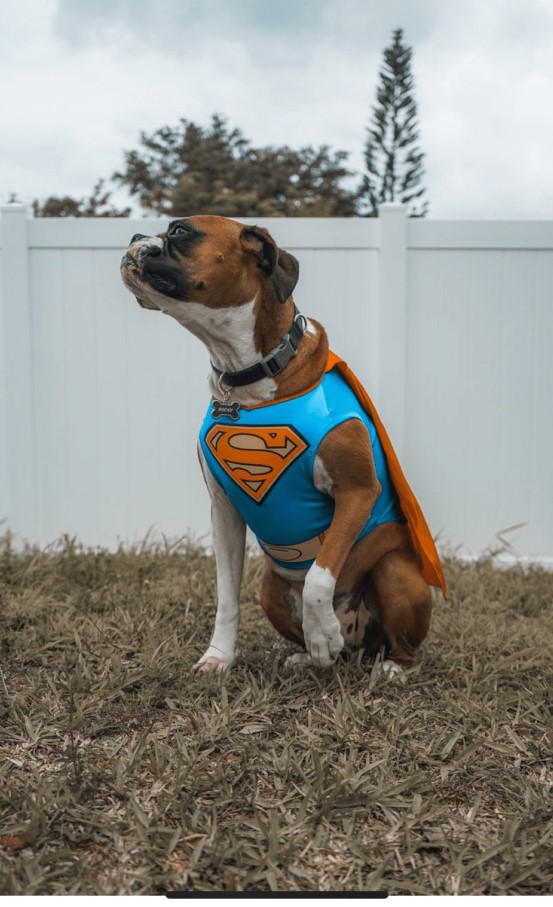
Staring up, beyond the confines of my yard Up into the sky, so wide and blue Paws poised Ears and eyes alert Ready to run, jump, fly! Don’t try to stop me, no… On I go, Go, Superdog, Go!
Image credit: Elias Castillo @ Unsplash The image shows a dog wearing a shirt with “Superman” logo on it. There is a cape flowing from the back of the T- shirt.
It’s half the way through the year already, can you believe it? Almost the end of June and it’s wet and wintry here, and while many of you are enjoying your ‘summer reading’ and I thought I’d share what I’ve been reading this year. I love to read almost as much as I love to write, and I firmly believe that the more good writing I read, the more my own writing improves.
Last year I did the ArmedWithABingo year-long reading challenge hosted by Kriti Khare & Ariel Joy which was great fun, and which encouraged my to read a few books that I probably wouldn’t have otherwise picked up. But this year I’m on a ‘free choice’ foray, guided mostly by some great reviews I’ve read by some great reviewers here in our WordPress family, who’ve wickedly tempted me to augment my already tottering ‘TBR’ pile way beyond normal safety parameters.
I’ve also over-stuffed my book shelves with piles of pre-loved books from our local indie book stores.
However, I must confess to my shame that I haven’t been to our lovely local library for ages. I really should, even though under lockdown regulations you can only spend half an hour at a time there. Before Covid, I used to go to write there sometimes since being surrounded by all those books was rather inspiring (and it’s lovely and warm in winter).
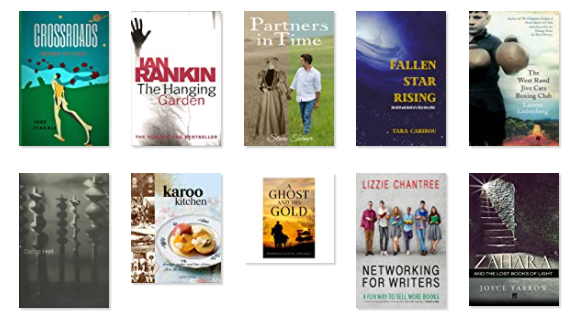
Anyway, enough rambling. Here’s what I’ve read so far this year.
My books on Goodreads
I’ve had a most enjoyable half-year’s reading: a mixture of old books and new, prose and poetry, even a cookery book. I’ve continued to honour my resolve to read more books from the southern hemisphere, especially by African writers, as I feel authors down here don’t get the exposure they should.
As a writer I know how exciting it is to receive a review from a reader, and I offer a big, big thank you to all of my readers who’ve taken the time and trouble to rate/review my books, although to know someone has read one of my books is even enough.
I faithfully post a review of the books I’ve read on Goodreads and usually on Bookbub, so long as the book comes up in a search. You can find all of my reviews here on Goodreads.
As for the next half of the year, I did promise myself not to buy any more books until I’d made a proper dent in the tottering TBR pile, but there’s a sale at Bookworms tomorrow, and I have to support the store which carries copies of my own books, don’t I?
As the sun’s pink fingertipscaress the tops of the purple mountains behind the cave, Owab is the first of the hunters to wake. Aquila waiting for him outside. The eagle bows and turns to the east, where a procession of wispy clouds rises with the dawn. Aquila takes to the air and Owab, in the thrall of his night-time vision, follows where his guide and protector leads.
When they return, Owab is leading a long-legged rain-cow which will bring soft raindrops to last a whole season.
The Great Bull bellows rain swells the gathering clouds: the parched land awaits.
This concludes my little African adventure, although I wouldn’t rule out a comeback for Owab and Aquila sometime in the future. You can find the previous episodes here.
Image credit: Dakota Corbin @ Unsplash The image shows a wall decorated by splashes of colour. There are outlined sketches of two hands on the wall. Above the decorations, the words “The best gift is you” are written. A woman can be seen walking a baby in a stroller in the front.









 luna's on line