Liebster Award: I’ve been nominated!

LiebsterAward

Yay! I was so chuffed to be nominated for the Liebster award by awesome author and blogger, JI Rogers. It was just over a month ago (how time flies when you’re having fun writing, or sitting thinking about writing, or just sitting…). But now I’m acting on that nomination and passing on to another 11 people.

So, the Liebster Award; this is how it works:

‡ Step 1
Acknowledge the person who nominated you

Thank you JI Rogers for the nomination! She’s a very special author and blogger; do go and visit her site: jirogers-author.com to see all that she’s working on. She’s an artist too, see her work at mythspinnerstudios.com

I first came across Jenn through her Six Word Story Challenge and have been having fun with it ever since. And I recently read Book One of the Korpes Files and you should too! It’s a really good read… and I can’t wait for the second book to be published. See my ‘Good Reads’ review of it over there on the right.

‡ Step 2
Answer the 11 questions your nominator asked you

  1. What do you feel is the best blog post you’ve written to date and why?

It was a little flash fiction piece entitled ‘The Beautiful Game?‘ which was prompted by an article I read about domestic violence increasing in the UK during the World (Soccer) Cup. I provoked some interesting reactions and I hope helped to raise awareness.

  1. If you had to choose one of your current projects to tell a group of strangers about, what would it be?

It would have to be my work-in-progress novel. I’m nearing the end of the first major draft and I’m getting quite excited about it, so I hope my enthusiasm would come across.

  1. Who in your life (living or dead) provided you with the best inspiration?

My high school geography teacher. She was an eccentric ‘old school’ spinster who had fantastic enthusiasm for travel and life in general. She was at Cambridge University in the early 1950s, a scholarship girl too. We thought her rather old and quite batty at the time, but then she’d have been more than 10 years younger than I am now (which is a bit scary, thinking about it). She didn’t partticularly inspire me to write, but to live bravely.

  1. What book would you recommend that everyone read?

Mine of course! – The Silver Locket
Otherwise, for aspiring writers I’d say ‘On Writing’ by Stephen King.
And for a beautiful read and to experience the craft in action: any novel by Isabel Allende or Kate Atkinson or Margaret Atwood or Jane Austin… that’s just the ‘A’s.

  1. What is your favourite movie?

No contest: ‘Casablanca’. A total classic and timeless.

  1. Hypothetical: You’re a well-paid guinea-pig being abandoned on a remote tropical island for an extended period (several years). You have ample food supplies, shelter (even indoor plumbing), electricity, and a decent computer… but the internet is non-existent, and you will have no human contact. One of the scientists takes pity on you and will leave you an external drive with movies, TV/Netflix series, games, and books on it, but the catch is it can only be one genre. Which genre would you choose?

This is the hardest question. I just want to say ‘fiction’, but I don’t think that’s really an answer. I could narrow it down to ‘Speculative Fiction’… I’d be happy just take the books!

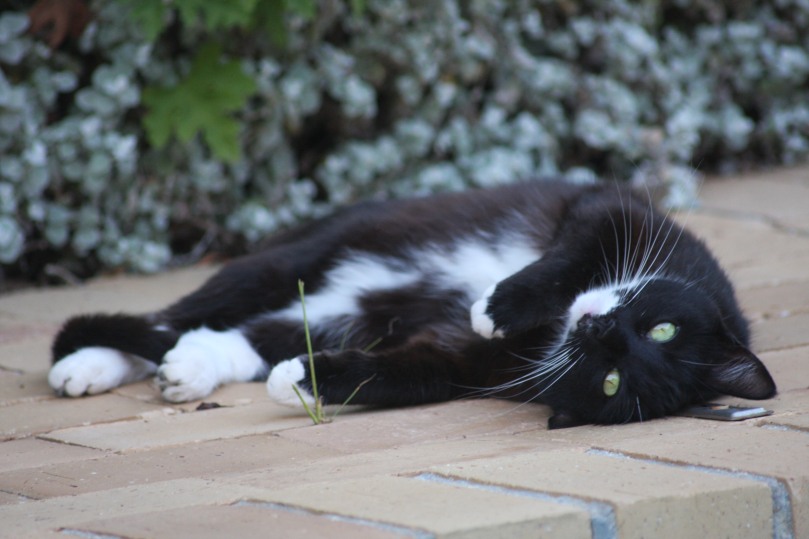
  1. Cat, dog or other?

Cat. Have you met Luna?
IMG_7201

  1. When you’re being creative, do you prefer quiet or some form of sound (music, audiobook…) in the background?

Quiet suits me. My writing room has windows into the garden, so there is a soundtrack: birdsong, the chattering of squirrels and the clucking of my hens. Once I’m in ‘the zone’ I can write almost anywhere and under almost any conditions.

  1. What can move you more, images or words?

Words; they create the mental pictures. That’s why I prefer radio to TV a lot of the time.

  1. If you could be assured of accomplishing one thing with your life, what would be your magnum opus?

A brilliant, acclaimed, best-selling, literary novel preferably recognised during my lifetime. Otherwise all the proceeds go the cat!

  1. What is your favourite colour?

I find yellow very stimulating and that’s the colour of the walls in my writing room. Not a colour I’d wear though.

‡ Step 3
Nominate 11 other bloggers

C J Stark: http://seejaystark.com/

Debra Tracy, Nana’s World Web: https://nanasworldweb.com/

Ellie Scott: https://www.elliescott.co.uk/

gwladysdillon: https://whenyougorragoyougorragetgoing.wordpress.com/

The Haunted Wordsmith: https://thehauntedwordsmith.wordpress.com/

Nicole Melanson, Word Mothers: https://wordmothers.com/

Mickey & Yunni, Freja Travels: https://frejatravels.com

Thomas Stark, Short Worlds: https://shortworlds.wordpress.com/

The Dark Netizen: https://thedarknetizen.wordpress.com/

Adam West, The Writer of Age: https://writerofage.com/

Wide Eyed Wanderer: https://wideeyedwanderingspoonie.wordpress.com/

‡ Step 4
Ask them 11 questions:

  1. We are an international community. Where in the world do you come from and where do you live now?
  2. Plotter or pantser?
  3. What’s on your writing desk?
  4. What have you written which has given you a real buzz?
  5. What distracts you most when you are writing?
  6. How do you select the names of your characters?
  7. What do you enjoy most about the writing process?
  8. Have you ever sought revenge on someone by doing something bad to them in a story? Or conversely, have you given someone a happy ending?
  9. What’s the strangest thing you’ve done by way of research for your writing?
  10. You’re hosting a dinner with three other writers (living or dead). Who’s invited?
  11. What are you reading at the moment?

‡ Step 5
Let them know you’ve nominated them

Here goes… everyone should get a pingback!
Dear Nominees,
Don’t feel you have to react to the ‘chain letter’ element of this if you don’t want to, but if you do, please take the opportunity to promote yourself and your work BIG TIME

And finally, from me…

…and especially for you, dear reader, a heads up to let you know that my short story collection ‘A Sextet of Shorts’ will be free to download on Kindle from 1st to 7th August.
And if any of my nominees wish to post an offer or a link to any of their work anywhere in a reply to the award, the floor is yours!

Little Malice: the prequel

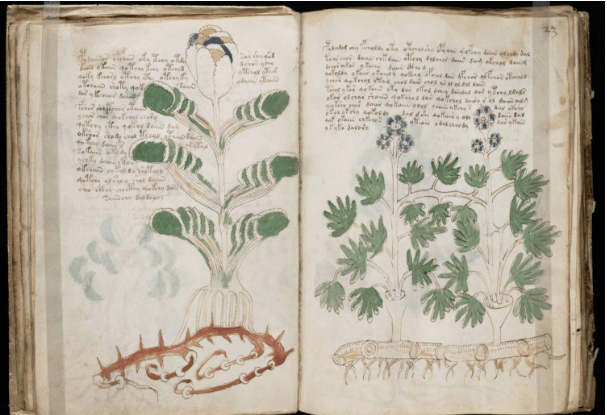
The Book lunasonline Voynich more Plants Credit Yale University
Credit: Yale University

From my Flash Fiction collection

I was sent to the Valley in my fourteenth year. I was given a little attic room and assigned as apprentice to the Herbalist beyond the Green.

She set me to work in the Storeroom, where I organised the shelves, made labels and lists. She was impressed with my lettering. Gradually I started to learn Herb-Craft: where to gather the freshest ingredients, what to plant and when to harvest, recipes for teas and tinctures, poultices and potions.

A year later, following the midsummer feast, she put me to work on the Book. I copied out new recipes, made illustrations, noted where and when certain plants could be found.  I began to assist in the Dispensing Room. She was pleased with me and with my work.

I learned that certain things displeased her. If she found me chatting too long whilst I was dispensing remedies, she would stand at the door, arms folded, tapping her foot. My friends soon took the hint. Or if she saw me spending time at a particular market stall, she would take me firmly by the elbow telling me to ‘come, leave that now’.

I worked with my pen and brush in the Storeroom at a little desk among the wooden shelves on which the flasks and jars were kept neatly in rows. Even on the hottest of days the Storeroom doors remained shut. No prying eyes were tolerated; the work was secret. I was sworn to keep those secrets.

One afternoon, I’d made myself a cup of herbal tea using leftovers from a poultice. She came in and sniffed my teacup. “What is this?” she asked. I explained. “Is it in the Book?” “No, it but was only a handful of leaves.” Her eyes flashed, “There must be no omissions from the Book.” She stabbed at the cover with fingers clenched and walked out.

Two years passed. My knowledge grew. I followed her rules; made sure she had no cause to admonish me. She taught me a little rudimentary Spell-Craft and the Storeroom prospered as never before.

One morning in late summer, when the dew was still fresh on the ground, I took my basket up to the head of the Valley to the source of a little stream I knew. There I found newly growing belladonna and wolfsbane. I picked a sprig of each and hurried to back to the Storeroom.

Later that afternoon, I settled down at the little desk with my brush and pen and my new specimens. I opened the Book and turned to the poison plants section. But it was missing. I checked again, carefully, page by page, but it was as if the pages had never existed.

I hurried over to her little house and called her. She followed me slowly and sat down at the desk. I showed her where the missing pages should have been; how they seemed to have disappeared into thin air. I thought she’d be cross and give me that look, so I prepared myself. But she looked up at me and said “Never mind now.” She laid her wrinkled hand on my arm: “Go home; I’ll see you in the morning.”

The Storeroom was unusually busy the next day and my morning was spent making up and dispensing remedies. It was only in the afternoon that I took the Book down. The moment I opened it, I could see something was wrong. Strange symbols had been written in the margins and there were untidy blots and crossings out. I didn’t understand.

I heard the Storeroom door open. She appeared in the doorway and came over to the desk. “Something’s happened to the Book,”’ I said, showing her.

“Only you use the Book. No one else has touched it.” She brought her face close to mine and I saw pure hatred on her face. “Why have you done this?”

“I haven’t done anything.” I felt myself starting to shake. I knew I hadn’t done anything. I stared up at her. “It wasn’t like this yesterday.” My stomach churned under her gaze. “We looked at it together, remember? The missing pages?”

“I know you did it.” Her voice was like gravel.

I stood up, facing her across the little desk. I held her stare; not this time, I thought. There was a burning smell. I looked down. Smoke was rising from the edges of the Book. The paper began to curl and suddenly the pages ignited. She slammed the Book shut.

“Go!” She pointed to the door. “Just go!”

I grabbed my basket and cloak and fled towards the Green. I looked back just once. There she stood, framed by the doorway. She glared back at me for a moment; then she slammed the Storeroom door shut.

I never went back. I avoided that part of the village and only went to the market during dispensing hours when I knew she’d be occupied. I could never rid myself of the memory of the expression of loathing on her face, or the power I’d felt that moment when the Book had ignited. I had been changed forever.

©2018 Chris Hall

Read what happened after that: Little Malice and Little Malice 2
About poisonous plants


How to Protect Against Plagiarism If You Post Fiction Online

A very important issue. Some useful guidance for those of you who like me are posting their work online.

theryanlanz's avatarRyan Lanz

by Sarah Pesce

Let me start this off by saying plagiarists are the WORST.

Unfortunately, plagiarism is made easier than ever with self-publishing these days. If you post your work online – on fanfic forums, on Wattpad, on critique sites, on your own website, etc. – you run the risk of that work being stolen and put up for sale as an ebook, with someone else potentially making money off of your labour.

View original post 1,394 more words

How Writers Can Relax

I really like this post! Go on, take the advice.
I should tell you though, I already do most of this, most of the time.
Plus, I drink wine too (later on).

theryanlanz's avatarRyan Lanz

by S.E. White

We’re almost halfway through the year, so now is the appropriate time to hear about some of the methods authors use to unwind. A little self-care, a little stopping to smell the roses, and your writing productivity will thank you.

These are all tried and tested ways that writers relax. They’re reliable things to try if the breakneck pace of writing is wearing down your physical and mental health. They’re also science based*, so attempt them with confidence.

View original post 430 more words

Man on a mission

Man on a mission flash fiction lunasonline

Sanchez rises early. He dons his trench-coat, pulls on his hat.

Sliding stealthily through the silent streets, a dark, fast-moving, shadow. Hat pulled down, collar turned up, he passes through the checkpoint unchallenged. Now he’s in the ‘other’ city.

He’s closer now. He slows down and looks around. His eyes flick left, flick right. Careful, as he watches comings and goings of the grey-clad people. He times his move, then scurries across the square. He waits hunched in a doorway. A clock strikes.

He hears the click-clicking of heels on the flagstones; getting closer. He glances at the reflection in the window opposite. He tenses, wired for action. The woman draws level with him.

He springs out, reaches into his raincoat, pulls out a single red rose. He hands it to her. She smiles.

Then he’s gone. Mission accomplished.

©2018 Chris Hall

Pingbacks (PSA)

I struggle with the techie stuff sometimes… I think this has shed a little light for me! Thanks to the Haunted Wordsmith: https://thehauntedwordsmith.wordpress.com/

Philip Pullman: ‘My Writing Day’

I came across this article written by the wonderful author, Philip Pullman. I found it very entertaining. It’s mostly about his writing space. Interesting. What’s yours like?

Courtesy of Guardian News & Media Ltd

Philip Pullman interview lunaslonline

Philip Pullman: ‘I use coloured pencils to show which key I’m writing in – D minor, at the moment’

The author on the importance of desk height, watching birds and Myriorama cards

I get to my desk (in a very small room at the top of the house) at about 10, and fiddle about with the height of the desk and the chair until I’m comfortable. I have a desk that I can raise or lower according to the state of my aching back. Sometimes I stand at it, and sometimes I have it high up to write at, and sometimes a bit lower to type.

The desk is covered by an ancient kilim, because it looks nice, but that’s not a good surface to write on, so I have one of those green safety cutting mats to support the paper I use, which is A4 narrow lined, with two holes. I love the shape of the A paper sizes. It’s the only one of Andrea Palladios recommended architectural shapes (the ratios of room length to width, and so on) that contains an irrational number, in this case the ratio of one to the square root of two. Very handy for illustrating Pythagoras’s famous theorem, in fact.

Nearby is a basket full of coloured pencils, including some of the best of all, the Berol Karisma range, now unfortunately discontinued. For each book I write, the paper is authorised for writing on by means of a coloured stripe along the top edge. I fan the sheets out and colour a stack at a time. The current book is a warm blend of Karisma Pumpkin Orange and Faber Castell Venetian Red. I sometimes think I should make it clear which key I’m writing a particular passage in – D minor, at the moment – but that would be silly, unlike colouring the pages, which makes perfect sense.

To read on, click here


A Dream (?)

A beautiful but dark poem highlighting the issue of domestic violence. Gently brutal.

Shreya Vohra's avatarPhoenix With A Pen

In the dead of night,
Under a moonlit sky,

I had a dream
About you and me.

I saw you hit me.
You beat me.

You didn’t even stop
When crimson clots

Were beginning to appear,
All over my skin.

I woke up.
In a pool of sweat.

But was relieved that
That was just a head trip.

Until one day when
Like all my other dreams

You turned this one too
Into reality.

IMG_0912 Image Source: Aunia Marie Kahn (Pinterest)

View original post

Bogged down in Botswana

Another Adventure in Botswana

Lake_Ngami_Discovered_by_Oswell,_Murray_and_Livingstone lunasonline

Lake Ngami, discovered by Oswell, Murray & Livingstone – from David Livingstone: Missionary Travels and Researches in South Africa, Including a Sketch of Sixteen Years’ Residence in the Interior of Africa, and a Journey from the Cape of Good Hope to Loanda on the West Coast, Thence Across the Continent, Down the River Zambesi, to the Eastern Ocean. London: John Murray, 1857.

Where David Livingstone had success, unfortunately we did not… a little bit of travelogue:

We had been searching for Lake Ngami the whole morning and were beginning to conclude that it had ceased to exist, despite it being an ‘Internationally Important Wetland,’ according to the sign which we’d found facing belly up at the roadside. It was, after all, the dry season.

We had driven across the eastern side of what, we assumed, had been the lake. The landscape was dry and desolate, populated only by a scattering of dead trees and the occasional hopeful-looking bird. We’d retraced our route.

Regaining the original road, we decided to go for one last try down the uneven track where we’d concluded the important-looking sign had pointed. After sometime driving on the worsening roadway, we passed several rondavels. I waved to a group of Herero women in their traditional costumes with their iconic cow horn-shaped headwear. We saw goats and chickens roaming around contentedly, and a bunch of small children who waved cheerily at us. We waved back. There was a lot of waving to be done.

But there was no sign of the lake.

We pressed on through the village; everyone looked puzzled but friendly, grinning at us with white-toothed smiles. I peered at the map; this couldn’t be right.

Defeated, we decided to turn around. The vehicle slid uncomfortably in the soft sand. The wheels turned, but we were going nowhere. The engine stalled. We started up again, but the rear wheels dug further into the sand. We stalled again.

My husband got out and circled the vehicle; I watched him in the side mirror staring at the back wheels, hands on hips. He disappeared from view and returned with a handful of twigs which he started to stuff under the wheels.

Another try and again the wheels failed to grip. The group of children which we waved at earlier appeared, attracted by the sound. An older youth with them approached and informed us in excellent English, that a spade would be fetched. We needed to ‘dig deep’. A smaller child disappeared in the direction of the nearest rondavel. Moments later he returned, armed with a small spade with a broken handle.

With great enthusiasm the little team of helpers gathered round my husband, all intent on assisting with the digging. Small boys burrowed under the vehicle and renewed attempts were made to drive out. But the wheels continued to sink into the sand. ‘We need to dig deeper’, came the cry.

An older man wandered over, an un-lit cigarette clamped between his lips. After a short conference with the helpers, two of them disappeared, reappearing with two large roof tiles. The tiles were positioned under the rear wheels; my husband gripped the steering wheel and started the car. There were crunching noises and an ominous burning smell. The afternoon shadows lengthened.

More digging, another attempt, the front of the car rose higher. From this an unusual angle a red and white-painted mast in the distance caught my eye.

I fished in my bag for my cell-phone and scrabbled for the receipt on which I’d written Carlton’s cell number. Just in case, I had said back in his little office, when we’d picked up the vehicle.

My cell-phone rang out. ‘Carlton?’ ‘Yes?’ I explained the problem. ‘Have you engaged the 4-wheel drive?’ I summoned my husband and relayed instructions relating to a small knob under the steering wheel. He complied, started the engine and pressed the accelerator. The car moved off. There was a cheer; they’d done it! Rewards were dispensed to our gallant team. We didn’t mention my phone call as we waved goodbye.

©2018 Chris Hall


The best reference for authors

Elements of Style by Struck & White lunasonlineReading a blog post from Cristian Mihai in The Art of Blogging, earlier this week reminded how useful I’ve found this little book over the years. Most recently, when I was doing a spot of editing for my good friend, Paul English, whose latest book, “Fire Angel: Turning Point”  from his ‘Fire Angel Universe’ series, is just out now.

Strunk and White’s “The Elements of Style” was first introduced to me by the wonderful Ursula K. Le Guin (sadly no longer with us), in her excellent book on story writing: “Steering the Craft”, which was a huge help to me early on in my writing life.

Read what Cristian Mihai says about it in his post: ‘The (Very Short) Ultimate Guide to Blogging’