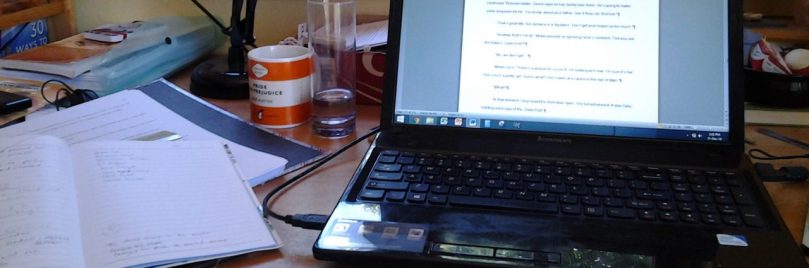
It’s started and not quite as I’d imagined. Of course, I must start by coming clean and admitting to those who didn’t catch my admission on Twitter the other day, that I haven’t signed up for this properly and officially.
No. I decided to be easy(ish) on myself and aim for a modest target of 20,000 – 30,000 words. A children’s story. Something I could add to later: parts two and three perhaps.
So, at the start of the week, I did a little light planning, which was good. Feeling confident!
And then midweek, and I shouldn’t complain, I got a whole bunch of ‘proper work’ to do. That, incidentally, means paid work for clients which, of course is good. But it did include reproducing a 28 page, closely worded, legal document, which took hours (it’s not something I’d normally do) and it numbed my brain, something chronic!
NaNoWriMo Day One – 7,239 words… and none of them fiction! Day Two has been better.
Good luck to everyone who’s doing this! I wish you very well. See you next month.
This post is about an acknowledgment of gratitude. In the recent event of releasing a story, and the errs along its way to a patient recipient.
Firstly, thank you, Chris Hall, a WordPress blogger, and published author, you have followed and offered wonderful feedback for some time, and I appreciate that greatly!
Doubly, thank you for the -and it’s a rough guess- 30+ emails we exchanged trying to send an ebook, across country borders. There were miscues, moments where it seemed like it would work, then didn’t. Well, eventually, with combined efforts and determination, we found success!
Thank you, Chris, for your interest in The Vague Ship, and help in discovering how to share books across the world!
Just to let you know that I won’t be around quite so much for the next 6 weeks. It’s nothing bad.
I promised myself at the beginning of March that I would finish the draft of my new novel by the end of October (this year), and then do something I’ve never done before, and which I’ve wanted to do for almost 10 years: NaNoWriMo.
2018 is the year.
It’s going to be a challenge because I’m going to have to plan this properly.
Starting…now! Well, soon.
I’ll be popping up for air to see what everyone’s up to, but if I don’t interact with you much, you’ll know it’s going well. If I do start wittering on it will mean I’m prevaricating which will not be so good. You might even find me crying in a corner of Twitter.
I come across this article by one of my favourite authors, Kate Atkinson, which she wrote in response to a review of her latest novel by the American novelist Jonathan Dee in the New Yorker.
You can read the full article for yourself by following the the link below, but as I was reading, I was initially incensed on her behalf by Dee describing her as ‘matronly’. I mean, how dare he? (Note that Ms Atkinson is a contemporary of mine, even down to having grown up in the same city, not that we knew each other).
In his review, Dee makes much of a comparison with the work of Rachel Cusk, who is an exponent of “autofiction” (a form of fictionalised autobiography). There’s a further link in the main article to a piece about this form of expression, which is apparently gaining in popularity. It’s not something I’d care to explore; writing from the imagination seems to me to be the whole point of novel writing.
But back to the point about authors reviewing authors. Reviews are important, and I’m very grateful for the lovely reviews I’ve received on my published work so far. I believe that we should try to support each other and if we really don’t like a book, maybe just keep our opinions private.
Some food for thought here. What’s your view?
Courtesy of Guardian News & Media Ltd
Kate Atkinson calls authors reviewing their peers a ‘callous art’
British novelist who recently published latest book “Transcription” says she tries not to read bad reviews
Kate Atkinson, Author (and not at all matronly)
The literary world is packed with novelists reviewing the books of their colleagues but it is not somethingKate Atkinsonwould do, calling it a “callous art”.
I remember The Time Before. The time before The Changes, before the bees died all over the world. Suddenly. All wiped out. It was that one dreadful year when things started to break down. Lots of things happened, but it was all about the bees.
We knew they were important.
We knew they were vital.
We knew they were vital for life.
Everyone had predicted it would be a catastrophe; but it turned out there was hope. There was a work-around; people with technology, scientists, biologists, cyberneticists. They had a plan.
They brought out the drones. Not the only-good-for-one-thing males of the bee species. No, these were machines.
But we didn’t realise that these tiny robots were more than just little automated pollinators.
Did you know about the waggle dance? The one a bee did to tell other bees where to find the good stuff. No? Well it doesn’t matter. What does matter is that the new drones, the cute little bee drones, have eyes everywhere. They’re watching us. So you’d better toe the line.
They don’t do a dance, but they do tell their masters.
They watch; their masters observe.
Their masters control. Your life.
Everyone had predicted it would be a catastrophe, and it was. But not in the way people had thought. And now nothing is like it was in The Time Before.
A few weeks ago I told you about a little marketing initiative which I cooked up with my writing buddy, Paul English, involving a donation of the first two published books in hisFire Angel Universe series to a school library.Giving a Fellow Author a Plug!
Now I’m pleased to say that the article I submitted to our local newspaper, The Bolander, was published yesterday, both online and in print. ‘This is a long established popular community title which is distributed to 31 150 readers’ homes. Readers receive hyper local content with a focus on community news, including local personalities, advice and editorial columns, reader’s letters and sport.’ So it’s a good place in which to be featured!
Here’s the link to the online article, which Paul and I have shared far and wide (so you might even have seen it already): Author Unleashes Fire Angel Series.
We also have print copies of our books out there: Paul has some in a local art gallery and in our favourite local bookstore, Bikini Beach Books.
I have some signed copies ofThe Silver Locketin our local Mexican Deli,Senor Onion, (thank you, Karen), they do great food by the way! And yesterday I presented a signed copy ofSextet to my podiatrist who promises to put it on top of the magazine pile in the waiting room after he and his receptionist have finished reading it (thanks, James)!
I came across this article by Kathy Steinmann the other day. I use Google quite a lot for quick fact checking, for example, I was interested in the properties of jade for my work-in-progress novel. And I use Google maps all the time.
I was aware of some of the things she mentioned, but not all, and some I’d forgotten about. See if you find something new and useful!
My second cross-continental collaboration with artist, Suzanne Starr.
This story was inspired by Suzanne’s drawing which I saw on myLinkedInfeed. Once again, I found the images of her characters so compelling that I had to write their story.
‘That’s a pretty dress, Miss Clara,’ said the Stork, as the little girl approached him. ‘Oh, but you look sad on your birthday. Why?’ She is so tall now, he thought.
‘I wish I could just fly away like you do,’ Clara looked up at him with her large brown eyes.
‘What’s wrong, Miss Clara? You have a lovely home with people who care for you. Why are you unhappy?’
‘It’s just that I feel like I don’t belong properly. They’re not my people, are they?’ Clara fiddled with her lace-edged handkerchief. ‘You explained to me last year, you delivered me to the wrong people. I’ve been thinking about it all year.’
The Stork cocked his head and looked intently at her. ‘I know, Miss Clara, and I told you how sorry I am for my mistake.’
‘Did you tell the other little girl?’ Clara looked up at him, ‘the one who should’ve come here instead of me.’
The Stork hung his head, ‘no Miss Clara, I didn’t. And perhaps I shouldn’t have told you.’
‘So why did you?’ Clara was on the verge of tears. ‘Why did you, Stork?’
‘The two of you were my first deliveries and I got it wrong. That’s why I kept coming back to check on you, until you were old enough for me to talk to you and to explain properly.’
‘And the other little girl?’
The Stork shook his head sadly. ‘The mother realised something was wrong.’
‘My mother? My real mother?’
The Stork nodded.
‘What happened?’
The Stork’s beak drooped so that it almost touched the ground. ‘She thought the baby was a changeling.’
‘A changeling? What’s that?’
‘Some people believe that a changeling is a fairy child left in place of a human child which has been stolen by the fairies.
‘But it wasn’t a fairy child?’
‘No, of course not. That’s just a silly superstition.’
‘So what happened to her?’
‘She was left out on the hillside as is the custom in that part of our country.’
‘I don’t understand. Why would they do that?’
The Stork sighed. ‘They hope that the real baby will be returned.’
‘Oh.’ Clara was silent. She twisted her handkerchief some more. ‘But why didn’t you tell her? The mother, I mean.’
‘She could neither see me nor hear me.’ The Stork started to pace about. ‘Only little children can see and hear the Storks,’ he said over his shoulder.
‘And you couldn’t save the baby from the hillside?’
The Stork turned to face her. ‘She’d gone by the time I found out what had happened.’
Clara frowned. ‘Maybe the fairies did take her.’
‘I don’t believe in fairies.’
‘But maybe someone found her. Maybe she’s with another family?’
A large tear rolled down the Stork’s beak. ‘Don’t you think I looked for her; that day, the next day, the next week?’ The Stork sniffed and shook his huge dark head. ‘I searched for months and years, because of my mistake. That’s why you’ve been so precious to me.’
Clara went up to the Stork; she reached up and put her hand on his neck. ‘Poor Stork, I’m sorry.’
‘I will always be sorry, Miss Clara.’
Clara thought for a moment. ‘Can we go there and have a look?’ Clara waved her handkerchief towards the sky. ‘I’d love just to see where I might’ve been living.’
The Stork looked at her, eyes unblinking.
‘I could ride on your back,’ Clara ran her hand over the snowy feathers on his back. ‘It can’t be that far. If you mixed us up on the same night,’ she reasoned.
‘No, Miss Clara. It’s not possible.’
‘But Stork…’
‘I said no!’ He turned his back on her, hunching his wings.
Clara sat down on the edge of the sidewalk and started to cry.
The Stork couldn’t bear to hear her sobbing; he turned around and nudged her with his beak. ‘I’m sorry, Miss Clara, but I can’t.’
‘But it’s my birthday today.’
‘That’s the point, I’m afraid.’ The Stork folded his long legs underneath his white feathers and huddled close to her. ‘Today is the last day you will be able to see me or hear me. You see this is your tenth birthday, and after you pass the hour of your birth, you too will be blind and deaf to the Storks.’
Clara looked at him. The Stork looked up at the sun which was sinking below the tall buildings of the city. The soft feathers of his cheek brushed against Clara’s hair. ‘It’s almost time, little one.’ The Stork stood up, gently helping Clara to her feet with a brush of his long beak. The Stork faced her and bowed gracefully as the disc of the sun disappeared behind the dome of the cathedral.
Clara looked at him, wiping away her tears. ‘Stork, dear Stork…’ and as she spoke, his image started to fade, so only a faint outline remained. His voice echoed around the little square. ‘Goodbye, Miss Clara.’ Then his was gone.
That night Clara had a dream, a very vivid dream. A girl about her age was waving to her from a bright, sunny hillside somewhere. She looked just how Clara imagined a fairy might look and she was smiling. And every year after that on her birthday, Clara found a soft white feather on her pillow.
*’He’s Back’ is one of two works by Suzanne Starr which form part of the ‘Into Darkness Exhibition’ at the Norwich Art Center, Connecticut USA. The exhibition runs throughout October 2018
If, like me, you cringe at the sight of the misplaced apostrophe and other grammatical ‘nasties’, then Eats, Shoots and Leaves is a ‘must-read’ for you.
Lynne Truss offers us her ‘Zero Tolerance Approach to Punctuation’ as an antidote to ignorance and indifference in the use and application of full stops, commas, question marks and more.
Full of rich and ridiculous examples of how the meaning of the English language can be distorted by the misuse, over-use and lack of use of correct punctuation, this is a hugely entertaining read.
Why the title?
So thoughtfully and wittily written, if you haven’t already come across it, I commend this book to you!
Find iton Goodreads and check out what other people have to say.
Some find it too preachy, but then I suspect that they’re not grammar gurus or punctuation pendants like me. I mean, who else kicks up a fuss in a Chinese chippy late at night at the sight of baked potatoe’s on the menu? Oh, really? You do? Good for you!
Written by Joe Moran, professor of English and Cultural History at Liverpool John Moores University and author of ‘Armchair Nation: An Intimate History of Britain in Front of the Television’.
Courtesy of Guardian News & Media Ltd
Extract from a page of Gustave Flaubert’s manuscript of Madame Bovary. Photograph: Alamy Stock Photo
Orwell advised cutting as many words as possible, Woolf found energy in verbs, and Baldwin aimed for ‘a sentence as clean as a bone’. What can we learn from celebrated authors about the art of writing well?
Every writer, of school age and older, is in the sentences game. The sentence is our writing commons, the shared ground where all writers walk. A poet writes in sentences, and so does the unsung author who came up with “Items trapped in doors cause delays”. The sentence is the Ur-unit, the core material, the granular element that must be got right or nothing will be right. For James Baldwin, the only goal was “to write a sentence as clean as a bone”.
What can celebrated writers teach the rest of us about the art of writing a great sentence? A common piece of writing advice is to make your sentences plain, unadorned and invisible. George Orwell gave this piece of advice its epigram: “Good prose is like a windowpane.” A reader should notice the words no more than someone looking through glass notices the glass.
Except that you do notice the glass. Picture an English window in 1946, when Orwell wrote that sentence. It would be smeared with grime from smoke and coal dust and, since houses were damp and windows single-glazed, wont to mist and ice over. The glass might still be cracked from air-raid gunfire or bombs, or covered with shatterproof coating to protect people from flying shards. An odd metaphor to use, then, for clear writing.