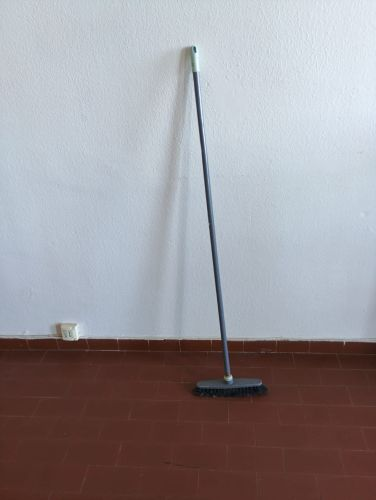
I enter the room, not much there I see a broom… or maybe, call it a brush?
I would much rather have an easel here
I’ll use a big, big brush to paint and using many colours
and of course it’ll be totally abstract!
my husband – the artist
~~~~
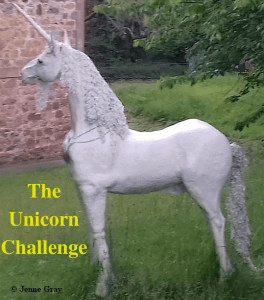
Posted for The Unicorn Challenge, a magical challenge hosted by Jenne Gray and C E Ayr, where they provide a photo and we, in turn, provide up to 250 words.
I can mostly talk okay now which is good! However, there is much to do.
Each day I choose to write three sentences with two words, using ‘Multiple Sentences Formulation’ and I do three different things.
I start to write carefully. It’s not easy.
I write on the laptop and then I listen to it.
Then I write it again, and I ask lovely husband, Cliff, to make sure that it’s right.
This takes a lot of time. You see, I can’t get the right word every time yet. Sometimes it could take more than five minutes! Even though I get frustrating. But it’s worth it.
I pop a little line here and there in WordPress. Also, once a week, I have been doing ‘Three Things Challenge’ on Wednesday with the wonderful Di at pensitivity101.
Spring has sprung in the West Coast (in the south hemisphere) and floral buds are springing up. The festive season is fast approaching and the villages and little towns are so abundant in beautiful wild flowers. 🌺🌼🌸
I like to read as much as I can. This is quite difficult still, although it’s much better. And how exciting when my lovely friend, Robbie, posted a few days ago, her ‘Roberta Writes’ for my book, Spirit of Shell Man – even though I can’t read properly yet!
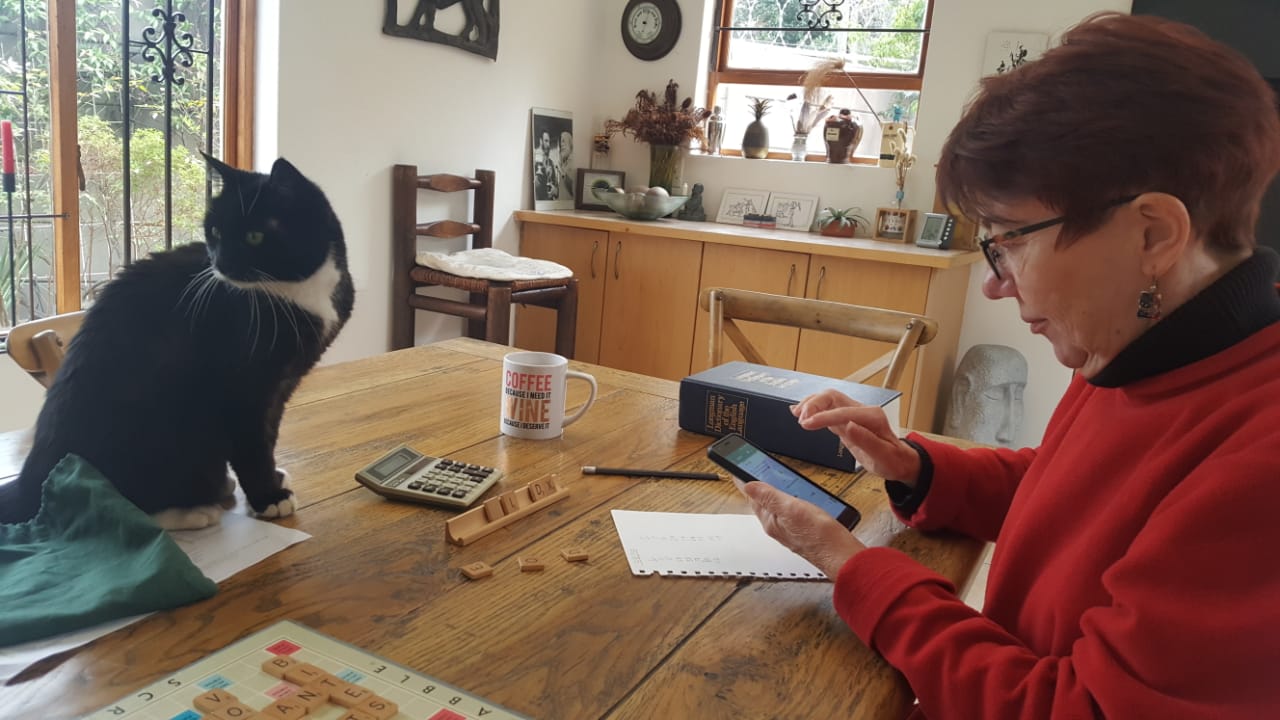
Finally, a little bit of numbers. Did you know that I have aways been a demon Scrabble person? This really helps and it’s such fun, with my great friend, Laurette, each Saturday morning. We have scored each time almost 500, and last week we got to 501! She also put a nice photo with me and my cat, Luna.
This is how it starting. Back from the void… ‘Coming Back’
And now, what can I see?
At the very start, it sees that the brain doesn’t recognise in my head properly at all.
Only listening.
Another few weeks. A little talking.
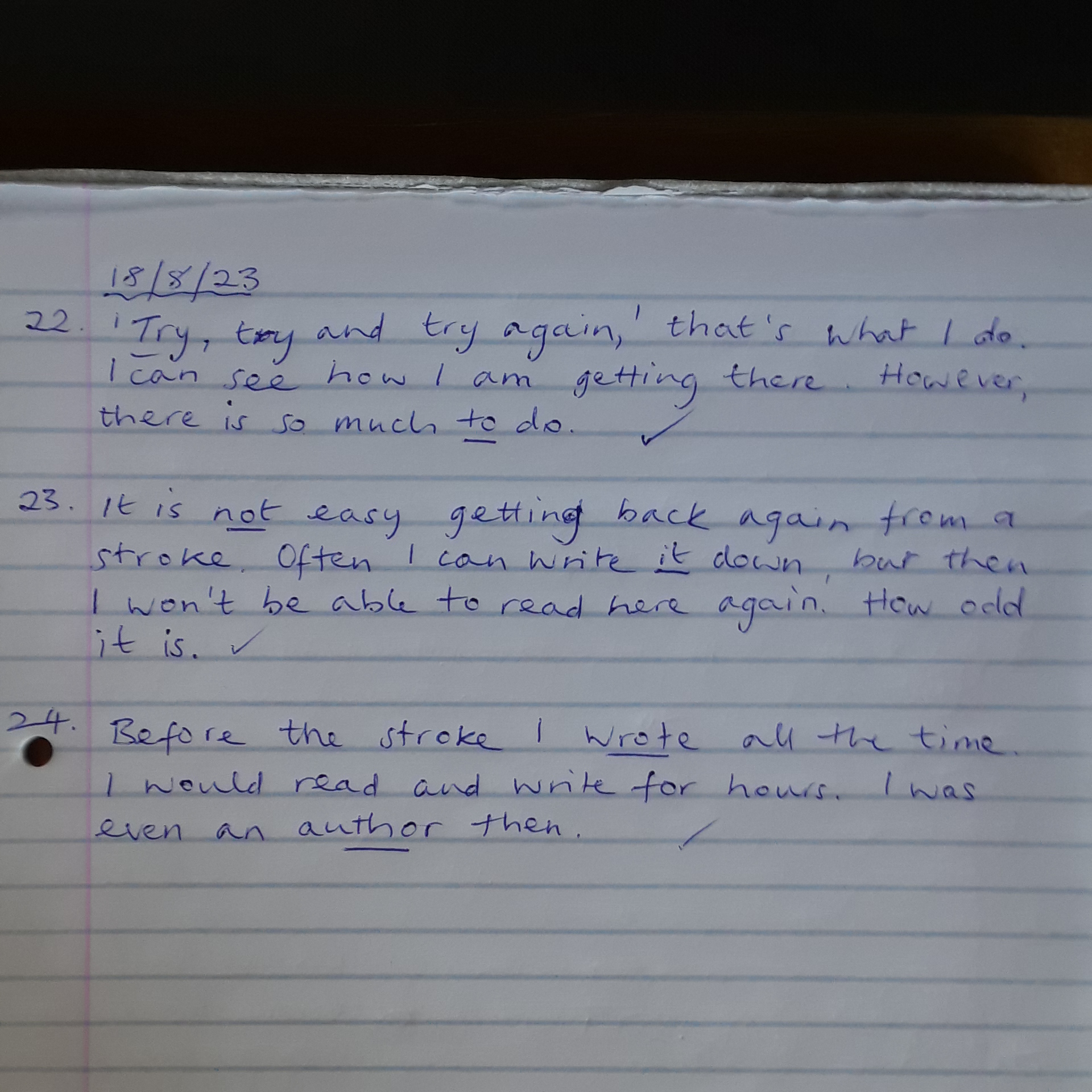
I look at my right hand. I need to write.
I move the pencil and the hand, and I look at my eyes..
This is how it works. (Sort of).
“Your eyes work, but the letters on the page have turned into squiggles. They make no sense. Now meet Howard Engel, a writer of detective stories, who has this condition, but amazingly, has found a way to trick his brain to almost read again.”
Something else
Much later, I find another writer. He had a ‘problem’ similarly to mine.
I am not quite right yet. My legs and arms and everything are good, although walking around is still a little odd. There is a little bit in my sight and I can’t see well on the right, but it is getting smaller.
My writing is getting so much better. Reading is still a bit difficult and talking is the same. Sometimes it is perfect but other times it disappears. Oh well.
So much has changed in my haemorrhage stroke, but at least I’m getting better. Slowly (very slowly) does it.
Now I get the gist of things in reading and writing. Before I would copy and paste on Word on my laptop were I can Read Aloud on Review. It’s not great but it’s all right. Of course, your clever people who read aloud on WordPress are fun. I can read pretty well now too and I can pop a little reply here and there.
Meanwhile, I will enjoy the Tour de France for three weeks. Just as I watched last year, although I could hardly speak at all then, and now I’m so much better, though there are quite a few of bumps in the way as I talk. It will get there, I’m sure.
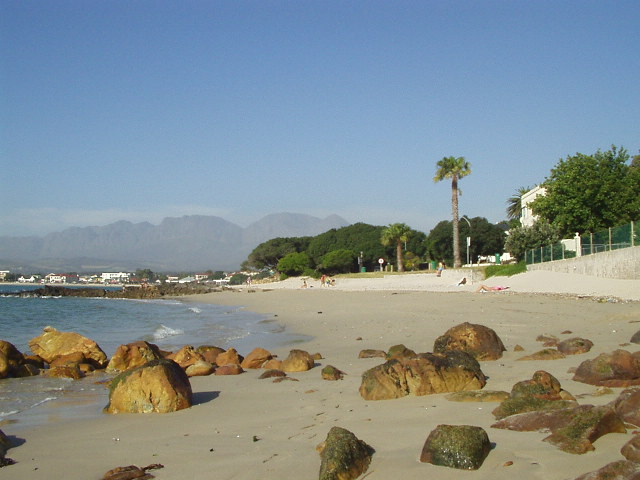
And we love to walk on over the beach, right by the ocean, near Cape Town – the best therapy, I know. Apart from all your excellent posts from WordPress.
Well, it’s been a strange time starting on the 19th June 2022. When, out of the blue, a haemorrhage stroke landed at my door. The next I knew, my brain has scrambled. Not great.
It’s taken many months, but I am on the mend.
However, now physically I’m brilliant. I am stronger and fitter (and beautifully thinner too). I am still improving my reading, writing and speaking, but still more time is required. It is so strange but it will be all right again.
Thank you very much, my friends from WordPress – so many who giving me support. Most of all, Cliff, my wonderful man, keeping me safe and sound. He is my soulmate.
And now you’ve seen me around and eventually I’ll be back properly.
Lovely, isn’t it? This sampler, inherited from my husband’s side of the family, is by far the oldest piece we have in our house. We don’t know much about the family members mentioned, only that they were part of the Dodding family who were prosperous merchants living in the Lake District, in the north-west of England. The family made a fortune and built a fancy house then a risky investment in a coal mine in Birmingham, which turned out to have no mineable coal, led them to lose most of their money. The fancy house had to be sold, but that’s about all I know of their story. One thing I do know is that ‘our’ Elizabeth wasn’t related to the much more famous Elizabeth Gaskell, English novelist, biographer and short story writer, although that would have been so cool – a famous writer in the family!
But that’s not the reason I’m sharing this particular family heirloom with you. It’s because it is a ‘little inspiration’.
I was pondering on what to post today, wandering about the house (as I do), when I found myself contemplating the sampler. As I stood before the sampler my thoughts drifted to a recent post by Jean Lee on ‘How do you name your characters.’ My response to this question, about which she expands so interestingly, was this: ‘Naming characters is like naming cats… I have to wait for them to whisper them to me.’
Then I remembered that it was while I was gazing at the sampler that William, from Following the Green Rabbit, whispered his name to me. The date is about right for the ‘olden times’ part of the story, and it’s a nice ‘solid’ name for his character. I’d already named his wife, Ellen, for my maternal grandmother. The name just seemed right, and it was she who inspired me to improve my cookery skills. Grandma Atkins gave me her recipe for Lancashire Hotpot which in turn became my first published piece anywhere!
Grandma Atkins’s Lancashire Hotpot recipe, published in the Sunday Times!
And the ‘little inspiration’ for Ellen showing Bethany how to card wool in the excerpt below? Well, that came from my former life in the 17th century.
So now, what better time to introduce you to William, as my young heroine Bethany first finds herself back in the ‘olden times’.
.
Excerpt from Following the Green Rabbit
“There was this man. He was dressed oddly, in sort of sacking stuff, but he had a nice, friendly face and I wasn’t afraid. He reminded me of Papa in a way, you know how his eyes pucker up at the edges when he smiles?” Bethany fell silent.
Bryony looked out across the garden; she blinked quickly then turned back to her sister. “A man, you say, in the woods? What did you do?” She glanced towards the kitchen door and over to Tom’s work shed, but there was no sign of either of their benevolent and hugely protective guardians.
“Well, he held out his hand to me, and I took it. He said something, but I didn’t quite understand him. He had a funny way of talking.”
Bryony’s eyes widened. “You took his hand? Beth…”
“I know I shouldn’t’ve done, but…” Bethany closed her eyes and shook her hands in front of her, like she did when she knew she’d done something wrong.
Bryony stretched out and grabbed her hands. “It’s all right; gently now. Take a deep breath and tell me.”
Bethany breathed in and out a few times.
“That’s better. Pray continue,” said Bryony, imitating the voice of the frightful Miss C.
Bethany looked up. “He told me his name was William and he lived with his wife nearby. We walked a little way and we came to his house. It was built out of stones and had a sort of straw roof, like one of the ones from the olden days in our big history book, except it seemed quite new. There was another little building too, like Tom’s workshop, and there were chickens running about outside.”
“His wife was called Ellen and she was sitting on a little bench outside the house. She had a big mound of white fluffy stuff next to her. She said it was from one of their sheep and she showed me how she was straightening it out with two big brushes.” Bethany frowned, putting her head on one side. “What did she call it?” She looked up at the sky. “Carding, that’s it. It was called carding. She showed me how to do it. Then we went into the house and she gave me some milk and biscuits.”
“Then Ellen said it was getting late. She and William looked at each other, you know, that funny kind of look which adults give each other, when we’re not supposed to understand something.” Bethany rolled her eyes. “Then William said that he’d walk me back to the village, so I explained that we didn’t live in the village. And they gave each other that look again. So I told them where we lived, but they didn’t know our house. They said there was no big house over the other side of the wood; just more trees.”
Bryony frowned. ‘How could they not know Bluebell Wood House?”
Bethany shrugged. “Perhaps I didn’t explain it very well. You know I get muddled up with directions. Anyway, they asked me to stay where I was and they went outside for a little while. When they came back they looked happy again. William said he’d take me back to the part of the woods where he first saw me and I’d be sure to find my way home. So that’s what we did.”
“I hope you thanked Ellen.”
“Yes,” Bethany rolled her eyes again. “You sound just like Hodge.”
“Who’s taking my name in vain?”
The two girls looked round. Hodge was carrying a basket of washing to hang out on the line.
“Oh, nothing. We were just saying we should thank you for our lunch,” said Bryony quickly.
“Well, you’re very welcome and you can show me your gratitude by clearing the table there.” She balanced the washing basket on her hip and picked the little carved robin up from the table. “That’s a pretty little thing, so it is. Where did you get it?”
‘I found it in the w… orchard,” stammered Bethany.
‘Hmm,” Hodge pursed her lips and put it down. She shifted the heavy basket in front of her. “Just mind you carry those lunch things in carefully,” she said turning away and continuing down the garden.
They started to clear the table. When Hodge was out of earshot Bethany picked up the robin and turned to her sister. “When William took me back to the woods he gave this to me and said it was a present to remember him and Ellen by. I took it from him and looked at it, but then when I looked up he’d gone. I didn’t even get the chance to thank him.” She stroked the little carving. “The funny thing is that when he gave it to me it looked like new. The colours were all bright and shiny. Now it looks as if it’s really old.”
~~~~~~~~~~~~~~~~~~~~~~~~~~~~~~~~~~~~~~~
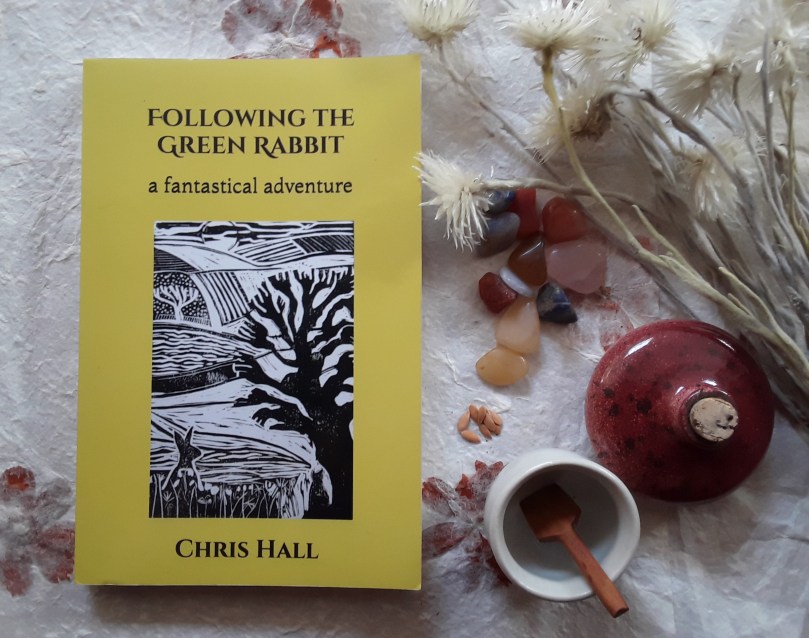
FOLLOWING THE GREEN RABBIT ~ a fantastical adventure
This morning’s #Writing My City workshop (re-arranged from last Friday when most people arrived too late to do anything, but never mind) took us to a whole new level.
Rather than prepare anything for group participation, I’d decided that we should just write, and then write some more. We had finished our previous workshop in writing mode and sure enough, stories had been written, at least partly.
I was so pleased to find that most of the group had written their stories in English (contrary to what they had told me they would do). I read each of them in turn in a quiet area, with their authors. And I had someone to help translate the two pieces which were written in Afrikaans.
The #WritingMyCity project is about the stories, not about how they are written, but reading stories phrased in the local vernacular is very pleasing.
The stories I read this morning are thought-provoking. They are disturbing and they have got under my skin. These stories have been told from the heart, and they are heart-wrenching. Most important of all, they are real. Powerful stories, written by women who lack power. All but one are from what we so tastefully call the ‘formerly disadvantaged communities’ as if they’re not still disadvantaged. All of these women have lived through very tough experiences.
For some, this writing journey has opened barely-healed wounds which are hard to deal with. But there will be support. For many of them it may offer a way to that special writing space which means so much to me. At least I hope so.
I’m saddened and humbled by their stories. I feel privileged that they have trusted me to read them. I am gratified that now they have the will and confidence to share them further by submitting them to the project.
When we let our stories out into the world next week we will celebrate… with cake!










 luna's on line