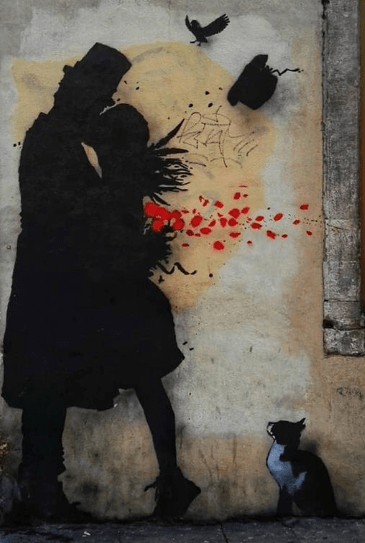
Vicklea, ofVickie’s Book Nook and Mediation Corner, nominated me last week to participate inThe Eclectic Contrarian’s challenge. The challenge is to be given a photo and then write a story based on the photo, hence the Tell The Story Challenge. The photo Vicklea gave me is above.
Here are the rules: Write a story about the picture you’re given. Select 3 nominees. Give them a new picture.
So, the story which, although prompted by the photo, is also a homage to my little old rooster who gave his last cock-a-doodle at the weekend.
Bird Life
The little rooster is first to awake, greeting the pre-dawn with his joyful call. Young squirrels start their chatter and mama guinea fowl calls from the fence top like a loud rusty gate.
The little rooster calls again; the hens shift about on their perches. He hops down and struts about, pecking at the floor of the hen-house, waiting for the day to begin.
The side gate opens. The hens hop down and jostle for position, peering through the chicken wire. Food arrives and with it, freedom. Pecking soon done, they all file out across the yard.
The little rooster rounds the corner of the house and sees mama sparrow tugging at the earth. Out pops a fat green caterpillar. She takes off and lands on the edge of her nest, offering it to the first new-born chick to raise its beak.
Then, a flash of yellow as a black-masked bird swoops in. The little rooster watches as he plucks another long strand of bamboo leaf and flies up to the high, high branch which sways over the pond, to weave it deftly into his beautifully-crafted nest.
Then the little rooster sees his favourite little black hen settled in the shade of the myrtle bush. He shuffles in beside her. He’ll take another stroll later; there’s no hurry.
We’d heard rumours of strange reptilian creatures stalking the lands beyond our borders. We’d not paid much attention. Similarly, we’d dismissed the reports which were sent back from the Palace Guard’s intelligence team who patrolled the perimeter of our kingdom. Men, far away from home are prone to flights of fancy and over-exaggeration. However, when the creatures did appear they were quite beyond imagination.
One spring morning they came, floating down from the fluffy white clouds under little canopies of sky-blue silk. We watched from our roof tops and our high city walls as they landed, then marched upon us, fanning out around the entire circumference of the city. We’d closed the heavy outer gates, pulled up the drawbridge and manned the battlements. But it was not enough. They were too large, too strong, too determined. And there were so many of them.
Our archers fired on them, but the arrows bounced off their patterned breast plates and scaly bodies. Within the hour they had peeled back our gates and smashed down our ramparts with their huge taloned paws. Our swords and spears were no match for them either. Once they had entered the city, they unslung their weapons and fired beams of sound and light which turned men to dust.
People scattered before them. Those who were too old or too slow were scooped up in their great scaly arms and flung aside with a force that snapped necks and broke bones. One of the creatures pulled a bleating goat from its tether and bit the poor animal’s head off. Then it split the body in two and tossed each half to its comrades who marched on either side.
What was left of the Palace Guard formed a ring around the entrance to the Sanctum where our queen and her council were gathered. The creatures filled the main square; row upon row of them. They stood in their ranks, facing our guards. Silence fell, punctuated only by the groans of the injured and the laments of the bereaved.
Then one of the creatures stepped forward; the symbols on its breastplate finer and more intricate than the rest. It advanced up the steps to face the Commander of the Palace Guard. Bringing a huge, scaly paw down on the Commander’s left shoulder it leant forward, forked tongue flickering.
At that moment, there was a strange roaring noise and suddenly, out of thin air a mysterious object appeared. A huge, great storage vessel, rather like the ones we use to store oil or wine, but much larger and made of a dull, grey metal. A door in the side of the object slid open and a tall, willowy figure dressed in a flowing silver gown appeared. The creatures in the square turned towards her, low whistling sounds emanating from their nostrils. They cowed their heads. She raised a shiny black staff and pointed it at their leader. She spoke and although her words were incomprehensible to us, we knew they were full of power. The lizard leader muttered something. She said a single, potent word and it vanished in a puff of smoke. Then she turned her shiny black staff on the massed ranks of creatures. Pop, pop, pop. They all disappeared. Then without a word, she returned to the vessel and the door closed behind her. The roaring noise sounded and the vessel was gone.
The old man finished his story and stared into the distance. Someone asked him a question.
“True? You ask me if my story’s true? Evidence?” He paused. “Well, if you look carefully there are some scorch marks near the entrance to the Sanctum.” The old man held up his finger. “And, I believe, fine sky-blue silk underwear is still worn here by women of a certain age.”
I smile as I watch my mother play with my little brother Tommy on the hearth-rug. My father sits in his chair, still but alert. Suddenly, out of the corner of my eye I detect a movement in the yard. I turn to look. Soldiers, four of them! By the way they are dressed, I know them instantly as ‘the enemy’. My father has followed my gaze as I gasp in fright and immediately he’s on his feet, sweeping up Tommy in the same movement and shoving him in my direction.
‘You know what to do Annie,’ he says quietly. He nods urgently at me and I grab Tommy’s hand and propel him through the kitchen. I look through the window, checking our route to the barn. It’s clear, so I open the door and we slide through and dash into the slatted wooden building. Behind us, I hear the soldiers hammering on the front door, shouting.
Although Tommy’s only little he knows what to do. Just as we’ve practiced so many times in recent months, I help him up the ladder to the hayloft. He doesn’t make a sound as we creep across the creaky boards and hide ourselves in the straw behind the loosely baled hay. We lie there, waiting. We haven’t practised what happens next. Then I hear a scream; I know it’s my mother, although the sound is like none I’ve ever heard her make. Her pain and terror flood my head. I grip Tommy tightly; he’s trembling and sobbing silently. The minutes tick by; I wonder what’s happening in the house. My father is shouting, but I can’t make out what he’s saying. The shouting stops abruptly and I hear the back door slam against the outside wall of the kitchen.
Heavy boots march towards the barn; I bite down hard on my knuckles. A cold fist contorts my stomach as I suddenly realise I forgot to drag the ladder up behind us. I hear the soldier’s heavy breathing down below. He’s pulling things over, searching. He approaches the ladder and in my mind’s eye I see him grab the ladder and place his boot on the first rung. Sweat runs down my back. Tommy is rigid in my arms.
There is a loud call from the house: ‘Move on!’ I hear the sound of the ladder clattering to the floor. It settles and there is no sound apart from the blood pumping in my ears. Slowly I get up, my legs are shaking. I grab the rail at the edge of the loft and feel for the rope which we use as a swing when it’s too wet to play outside. Telling Tommy to stay where his is, I let myself down and run quickly towards the back door which is gaping off its hinges.
Inside the house furniture has been overturned and one curtain has been ripped from the window. My mother cowers in a corner. Her blouse is torn and there is blood on her skirt. Father’s face is bruised and bloody. He reaches for her, but she turns her face to the wall.
That was the first piece from ‘A Sextet of Shorts’, my little book of short fiction pieces.
‘Sextet’ is currently available to download on your Kindle for $0.99 / €0.99 / £0.99 and other currency equivalents (+VAT) until midnight on 01.01.19.
And, since it’s the holidays, if you’d like a freebie, I will arrange to gift a download to the first 10 people who respond in the comments section below!
Things might not have turned out the way they did had it not been for the arrival of the new science teacher, Mr Wilde. Keen to engage his Year 8 class at the start of the new term, he had set up a series of elaborate experiments which had resulted in some rather dramatic indoor fireworks. At least no-one had been hurt.
Jimmy was definitely engaged. He was even moved to pursue his interest outside the classroom. Guided by some useful websites he created some modest but interesting explosions in the kitchen until his mother got fed up of cleaning up the resultant debris. He even produced a miniature volcano, much to the delight of Miss Johnson, the young geography teacher; even though it did erupt all over her desk and make a disgusting smell which lingered in her classroom for days.
A few days later during morning break, Jimmy had been searching the school grounds for discarded plastic bottles for his latest experiment. As he scoured the side of lane between the school and the rugby club, he overheard two of the teachers discussing the future of the school while enjoying a surreptitious cigarette.
‘If the club sells to the local authority, we’ll be able extend the school on the site here. If not, the school will close and then who knows what will happen.’ Jimmy recognised the voice of the Deputy Head, Mr Staines.
‘But surely they’ll sell. It’s only a pitch and a tatty old pavilion. How much are they offering?’ The second voice belonged to Mr Davis, his History teacher.
‘It’s not a question of the money. Apparently the rugby captain’s great grandfather founded the club here and his ashes were scattered over the foundations of the new pavilion when it was built in 1956.’
‘So our school has to close, just because of some old rugger bugger’s ashes?’
‘I know, still, one good storm and there won’t be a pavilion for the rugby captain to be sentimental about.’ Jimmy heard Mr Staines reply. He ducked back into the hedge as the Deputy Head stalked past him back towards the school building.
Mr Davidson lit another cigarette and stared glumly at the offending pavilion. ‘Well,’ he muttered to himself, ‘climate change might solve the problem.’
Jimmy found what he’d heard very disturbing. He liked his school. He liked the kids in his class and he even liked most of the teachers. He had never been fond of rugby.
That afternoon during double Maths, Jimmy had an idea. The more he pondered on it, the better it became. It was just a matter of getting hold of the right stuff from Mr Wilde’s chemicals cupboard.
On his way to school on the morning of Tuesday’s science class, he dropped into Mr Khalid’s shop. Proffering a crisp £5 note from his savings, he grasped a large handful of his friend Mattie’s preferred chocolate bars.
Matthew Albright was the class clown. Plump and good-natured, if sometimes a little slow on the uptake, he was quite happy to rise to the challenge when Jimmy suggested he should test out his acting skills in Chemistry in return for favourite chocolates.
Mr Wilde was starting to explain the procedure for setting up an experiment to grow copper sulphate crystals when suddenly Mattie clutched his ample stomach and let out a loud groan. Pulling a series of dreadful grimaces, he slid off his chair onto the floor, where he proceeded to writhe and moan. As Mr Wilde raced to Mattie’s side, Jimmy stole across the room to the teacher’s desk and extracted the key to the chemicals cupboard. While the rest of the class gathered round to watch Mattie’s performance, Jimmy quietly slipped the key into the lock, and let himself into the cupboard. He swiftly grabbed what he needed. Within a moments Jimmy was safely back in his seat, the key was back in the drawer and Mattie had made a miraculous recovery.
Acquiring the step ladder from Stan the Caretaker had been easy. As it happened Jimmy didn’t even need to create a diversion. He had been hanging around by his workshop when Stan had been summoned to go to the boys’ toilets on the first floor to deal with a flood. Stan stomped off muttering about paper towels and where he’d like to stick them, leaving the workshop door ajar. The step ladder crucial to Jimmy’s plan was swiftly liberated and stashed out of sight in the bushes behind the bike shed.
On a moonless November evening, Jimmy started to make his way towards the old wooden pavilion. He was carrying a torch and a small step ladder, and his duffle bag was slung over his shoulder. Propping the ladder against the side of the building, he climbed onto the flat roof of the shower block. He carefully dragged the ladder up beside him and crept across the roof. Jimmy prised open the skylight, gently manoeuvred the step ladder through the opening and lowered himself after it as it clattered to the floor. Jimmy took a deep breath. He opened the shower block door and stepped purposefully into the main part of the building.
Jimmy surveyed the interior by the light of his torch. Apart from some old plastic chairs stacked in the far corner and a few cardboard boxes piled up near the door there was nothing much inside. Jimmy dragged one of the larger boxes into the middle of the room. It had some writing on the side which looked like French; not one of his favourite subjects. He reached into his duffle bag and took out two containers. He shook out the contents of the first, making a small pile of reddish-brown powder on the top of the box. Then he carefully opened the second and gently added a white crystalline powder to the pile.
Next he took a large ball of thick twine to which he had tied a 1kg weight, taken from his mother’s kitchen. Using the step ladder, he reached up and hooked the twine over one of the beams which supported the asbestos sheet roof. Lowering the weight gently, he placed it on the floor. Returning to the shower block he positioned the step ladder under the roof light. Back in the main room he hoisted the weight up as high as he could, positioning it directly over the box. Grasping the ball of twine tightly he carefully paid out the thread as he climbed back up onto the roof. The twine was just long enough to allow him to reach the ground behind the wall of the shower block.
Jimmy paused, according to what he’d read, the two chemicals would be ignited by the percussive action of the falling weight. The resulting explosion should be sufficient to blow off part of the roof, a bit like a storm might. The sort of damage his teachers had been talking about.
He took a deep breath and released the twine. For a moment nothing happened, then there was a loud pop. Jimmy ran. Behind him there was a series of explosions. From the cover of the bushes, Jimmy saw the roof of the pavilion shatter and a succession of rockets explode into the night sky.
Had Jimmy been as keen at French as he was at Chemistry, he might have understood that the words on the box: ‘feux d’artifice’ meant fireworks.
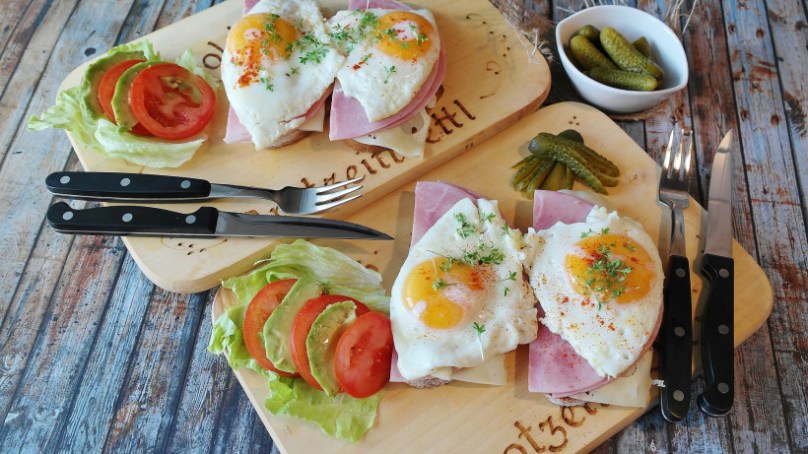
Written in response to the prompt by The Haunted Wordsmith: Hotel, breakfast, caught
Photo courtesy of The Haunted Wordsmith
Breakfast with Boris
Boris always enjoyed his hotelbreakfast when he was working away, even if it was sometimes difficult to obtain proper British grub. Not for him was bacon from Denmark or sausage from Germany. But today was going to be champion; a proper start to his day.
He rubbed his hands together as the waitress laid the groaning plate before him. He turned the pages of his copy of ‘The Times’ to the political section and propped the folded newspaper against the condiment set.
Tucking his linen napkin into his collar, Boris prepared to eat. He pierced a generous forkful of Cumberland sausage, stabbed a piece of Wiltshire bacon and dipped it into the golden yolk of his free-range Gloucestershire egg, before popping it into his mouth.
Then he started to read. The opinion piece was appalling. How dare this jumped up journalist decry his efforts to restore the autonomy of his beloved country! Boris drew a sharp intake of breath. The large piece of north-country sausage caught in his throat. Boris coughed. He tried to breathe in, but the prime piece of spiced ground pork was firmly lodged in his windpipe. He tried to cry out, but only a whisper of a bark came out. He attempted to attract attention by waving his newspaper frantically in the air.
British reserve to the fore, his fellow breakfasters ignored the disturbance. The waiting staff were absent from the room. No-one was coming to his aid. Boris’s face turned a delicate shade of puce. He struggled to his feet, cartwheeling his arms in a caricature of buffoonery.
But his efforts were to no avail. His face turned grey. He slumped back into his seat and keeled forward, his nose burying itself in the runny egg in the centre of the best Worcester plate on which his breakfast had been served.
Hoist on the petard of his Great British Breakfast, Boris breathed no more.
Written in response to the prompt by The Haunted Wordsmith: Dreaming, possible, peace
The little bear remained awake long after Emily had gone to sleep. He stared up at the ceiling wishing he could stay in this moment of perfect peace, wrapped in the arms of a dreaming little girl. “Merry Christmas, Benji,’ he whispered to himself.
Written in response to the prompt by The Haunted Wordsmith: gingerbread, town, catastrophe
Photo courtesy of The Haunted Wordsmith
The county news station is reporting from the town of Gingerbread.
Recent storms have caused extensive damage to a large number of houses in the area. When interviewed the mayor commented: ‘We have run out of the sugar, corn syrup and ginger, and consequently rebuilding efforts have had to be halted. We have declared the situation a catastrophe.’
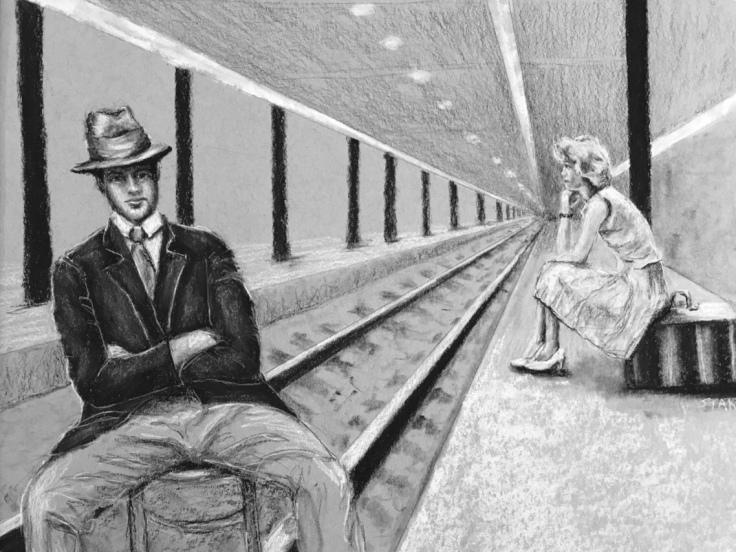
“Souls cross the skies of time, like clouds crossing the skies of the world.” David Mitchell, Cloud Atlas.
Charcoal drawing by Suzanne Starr
She sits and waits; a traveller. He sits, arms folded, staring into space where for him there is now only the present. Time stretches away. Infinite co-ordinates undefined. Souls slip past each other.
She stares at a wall, across tracks she cannot see; the tracks of time. The tracks of my tears. For I am that girl with no past and no future and I am waiting for you.
We agreed we’d meet, that we’d find each other. On the other side.
Before:
– Do you believe in reincarnation? – Maybe. – Do you think we come back as ghosts? – Perhaps. – If we do, shall we meet? – We’ll need to arrange where and when. – Each other’s birthdays? – Will you remember? – Of course. – Where then? – I don’t know. – We can decide later, there’s plenty of time.
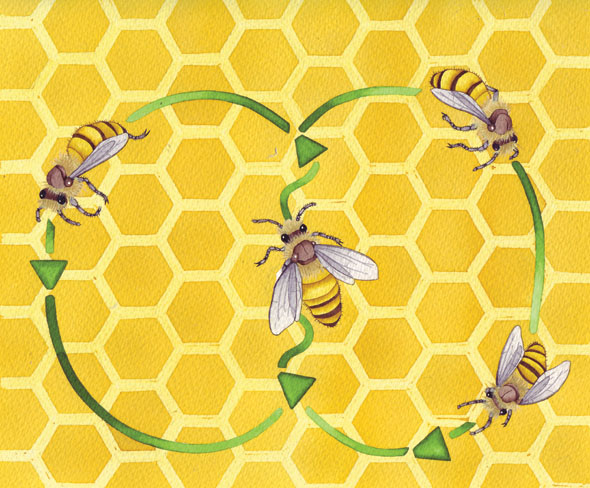
I remember The Time Before. The time before The Changes, before the bees died all over the world. Suddenly. All wiped out. It was that one dreadful year when things started to break down. Lots of things happened, but it was all about the bees.
We knew they were important.
We knew they were vital.
We knew they were vital for life.
Everyone had predicted it would be a catastrophe; but it turned out there was hope. There was a work-around; people with technology, scientists, biologists, cyberneticists. They had a plan.
They brought out the drones. Not the only-good-for-one-thing males of the bee species. No, these were machines.
But we didn’t realise that these tiny robots were more than just little automated pollinators.
Did you know about the waggle dance? The one a bee did to tell other bees where to find the good stuff. No? Well it doesn’t matter. What does matter is that the new drones, the cute little bee drones, have eyes everywhere. They’re watching us. So you’d better toe the line.
They don’t do a dance, but they do tell their masters.
They watch; their masters observe.
Their masters control. Your life.
Everyone had predicted it would be a catastrophe, and it was. But not in the way people had thought. And now nothing is like it was in The Time Before.