Sinead’s fear turned to relief then joy when, as the gloom lifted, she recognized the creature standing before them. It was the Hound of Hellidore. He who had saved her from the Minotaur back in the Maze of Mandoran. But hadn’t he been slain? She rushed to embrace him, but his resolute bearing restrained her and instead she bent down to pick up the Orb.
As she did so, it rolled beyond her reach. Sinead scuttled after it, scooping it up as it came to rest. Sinead straightened up, finding herself standing before a face, etched in stone, its expression contorted in agony. She stepped back in horror. It was the face of the Gatekeeper.
Sinead whirled around and found the Hound’s golden eyes staring back at her. He lowered his head and gave one sharp bark. Moonsprite pawed the ground. We must go!
Sinead flung herself onto Moonsprite’s back.
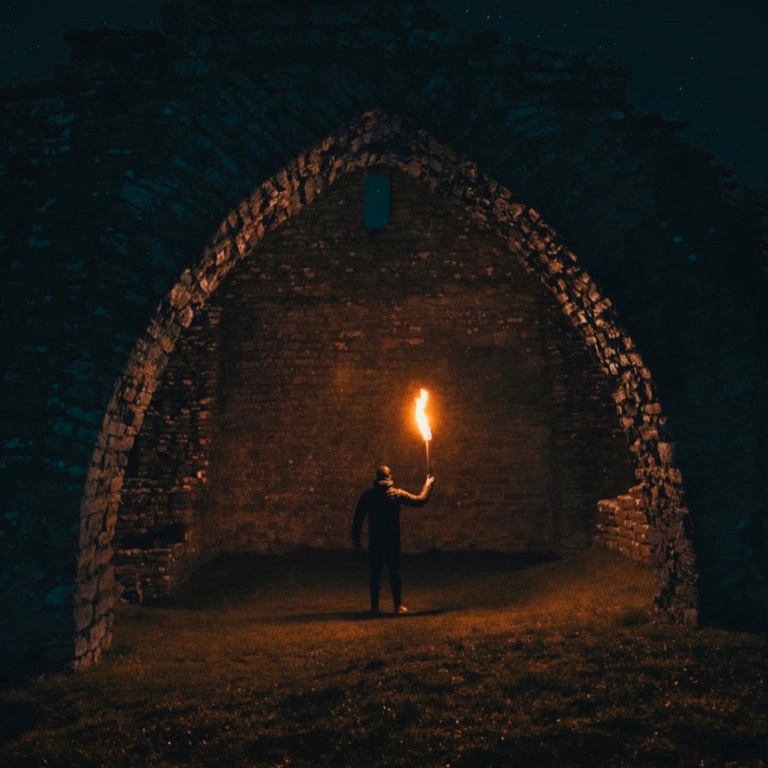
Image credit: wallpaperswide.com
Previous episodes of Sinead’s Final Quest an epic tale, unfolding in tiny 150 word increments.
The latest stop on our literary journey through my novels takes us to Daresbury, one of the numerous villages located in the rolling Cheshire plain, which was the inspiration for the village near Bluebell House, home to Bryony, Bethany and their tutor, Mr Eyre in Following the Green Rabbit.
Daresbury is not so physically close to Alderley Edge as the fictional village in the novel, but the overall impression of this pretty little village, with its narrow lanes and Victorian cottages, was the perfect backdrop for the action that was to play out in the story.
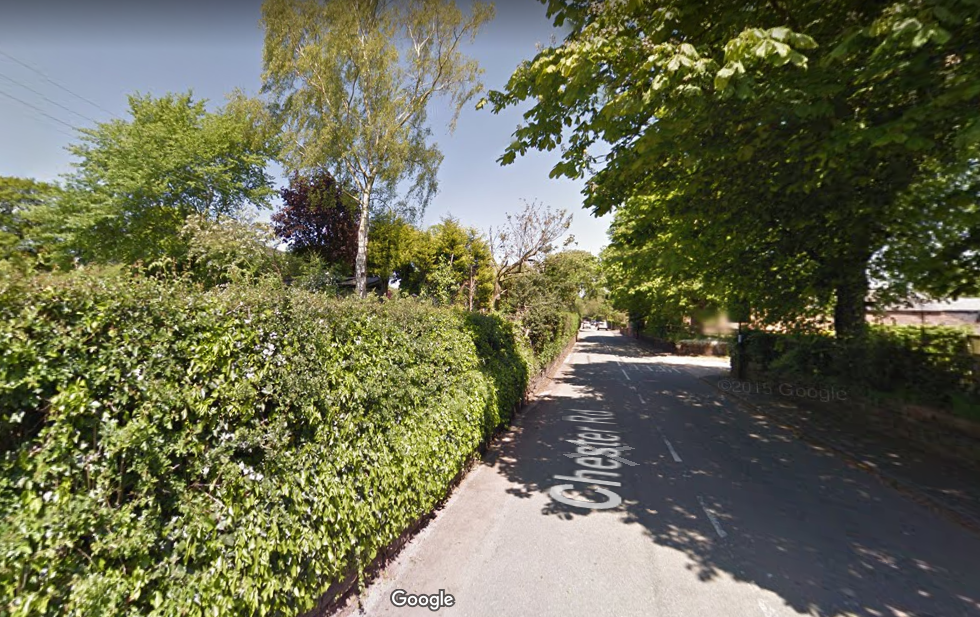
I first stumbled on this quaint little village (I’m hoping it still is) during a narrow boat holiday back in the 1980s. Searching for lunchtime refreshment, we set out from the canal, and struck out towards the nearest village, which actually turned out to be quite a tidy step! Even now, I remember the hedgerows that lined the narrow lanes, where we picked blackberries for a not-very-successful dessert that evening. We passed the church, and a little further along, we found the all-important ‘Ring’o’Bells’ public house.
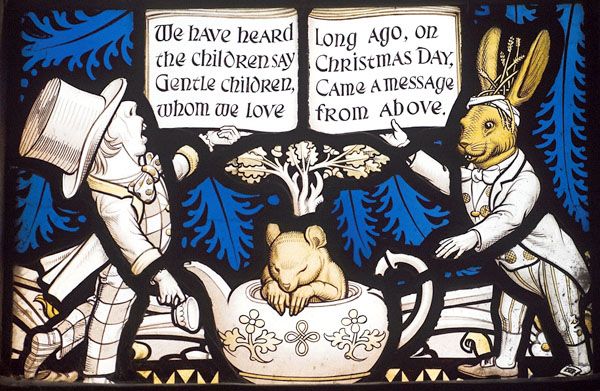
Not at all relevant to my story, but of interest, is the fact that Lewis Carroll (Charles Dodgson) was born at the vicarage in Daresbury. All Saint’s church has some wonderful stained-glass windows depicting scenes from Alice’s Adventures in Wonderland.
Lewis Carroll inspired window in All Saint’s Church, Daresbury
There’s a print of this lovely depiction hanging in my bathroom. Was it from this connection that I unconsciously introduced a strange green rabbit into the story? We don’t actually visit the interior of the church in the book. If we had, it might have sent Mr Eyre down a whole new rabbit hole. But I digress.
The village green is a key location in Following the Green Rabbit, but as far as I recall, there isn’t much of one in Daresbury, and I found myself remembering the one in the village in which I grew up, in Upper Poppleton, near York, way across the Pennines in Yorkshire. I have the impression that there were stocks on the corner of the Green at one time, but I think that’s just my imagination!
The Village Green in Upper Poppleton
Excerpt from ‘Following the Green Rabbit’
The village was a pleasant fifteen minute walk from Bluebell Wood House. The narrow lane was lined with leafy hedgerows where insects buzzed. “We collected blackberries and elderberries for jam along here last year, Mr Eyre.” Bryony pointed out a row of tall bramble bushes. “Look Bethany, there are so many again, and they’ll be ripe soon.”
“And did you eat as many as you picked?” Mr Eyre said, laughing as he rummaged about in the bushes, examining the fruit. “I know I did as a boy.”
“Do they have blackberries in London?” asked Bethany.
“Well, not in the city itself, apart from in some of the parks. But I grew up in Kent. I only went to London later on.”
They walked a little further. “So tell me, ladies of the flowering vine and house of figs, what other useful plants can we find here in the hedgerows?” He rubbed his chin. “You know we really should’ve brought a flora.”
“A flora?”
“Yes, you know, Miss Bryony, a book for identifying flowering plants. No doubt your Papa has such a volume in his collection?”
“Oh yes, I’m sure he has.”
Mr Eyre plucked a couple of likely samples from the hedge and tossed them into Bethany’s basket. He crouched before her, eyes wide with enthusiasm. “Maybe you could try drawing some of them?”
Bethany nodded happily.
“And I could label them,” added Bryony.
“Splendid idea,” Mr Eyre exclaimed, rising swiftly to his feet and waving his forefinger in the air. “Using the original Latin names, of course.” He spun around and pointed down the lane. “Now let us press on into the village.”
The lane broadened out at the crossroads at the edge of the village which boasted a line of neat brick-built houses arrayed around the village green. There were couple of stone water troughs for passing horses and, much to Mr Eyre’s delight, the old village stocks, which fortunately were padlocked shut, or otherwise, no doubt, he would have felt himself obliged to demonstrate.
The post office and general store was on the far side of the green. Mr Eyre lengthened his stride on seeing his objective and the girls almost had to run to keep up.
The little bell above the door tinkled as Mr Eyre opened it. Rosy-cheeked Mrs. Gilbert was standing behind the post office counter. She greeted the two girls warmly and asked when they were next expecting a letter from their parents. “So exciting dealing with post from so far away!” she exclaimed. Bryony answered politely and swiftly introduced Mr Eyre, who she noticed was twitching with impatience.
He rubbed his hands together. “Mrs. Gilbert, delighted to make your acquaintance. Tell me, have you a package for me? I am expecting one.”
“Likewise I’m sure, Mr Eyre, I’ll have a look in the back.” Mrs. Gilbert bustled through into the storeroom. A few moments later she returned with a parcel almost the size of a shoe box neatly-wrapped in brown paper. She looked at it inquisitively, peering up at Mr Eyre from behind her half-moon glasses.
“May I?” Mr Eyre put his hand out.
“A mystery parcel from my newest customer. What can it be?” she said curiously.
“Aha, you will have to wait and see, Mrs. G.” Mr Eyre replied, touching the side of his nose. He turned to the girls. “Miss Bryony, Miss Bethany, will you accompany me further?”
“Well I never did. Not a word of an answer,” said Mrs. Gilbert to herself as they left the shop.
Sinead shook the gates harder. No lock was visible, but they would not yield. They must be secured by an enchantment. Too slippery to climb, too high for even Moonsprite to jump, they were trapped in the bitterly-cold darkness. The Crystal’s light was fading and the night closing in.
The beast howled again. It was coming closer.
Sinead thrust the Crystal into Moonsprite’s saddle bag and pulled out the fabled Blue Orb, the most powerful weapon they possessed. The Orb had destroyed the last of the Oppressors, it would surely demolish the gates.
Sinead clasped the Orb in front of her and prepared to utter the sacred words.
Just as she was about to speak, a dark shape appeared out of the gloom and bounded towards the gates. Touched by the hot breath from its snapping jaws, the gates swung open.
The fabled Blue Orb rolled from Sinead’s startled hands.
Image credit: deviantart.com/anatofinnstark
Previous episodes of Sinead’s Final Quest an epic tale, unfolding in tiny 150 word increments.
Part 4 of our literary journey through my novels takes us far, far away from my former Liverpool home, the principal setting of ‘You’ll Never Walk Alone’, to the gritty and exotic island of Jamaica.
Liverpool has had a small, but significant Caribbean community since at least the early part of the 19th century. Concentrated in south-central Liverpool, a vibrant social scene is associated with it, which includes a number of night clubs and dance halls. Some of these only just survived into the 1980s, following the infamous Toxteth riots of 1981, like the fictitious New Jamaica Club where Gina finds the first clue to the whereabouts of her missing father, Godrell Clark.
The occasional late night drink in my student days at one or two of those surviving social clubs is as close as I’ve ever got to Jamaica though. Of course, it would have been wonderful to visit the country in the ‘interests of research’, but that wasn’t going to happen.
Keen to hit a note of authenticity, I spent some time on Mr Google, but that didn’t really give me the feel for the country I was seeking.So what was I going to do to get under the skin of the place?
Well, it probably won’t surprise you to discover that I turned to the world of fiction. I’ve always enjoyed reading novels set in places I’ve visited, or wanted to visit, so that was the voyage of discovery I took. The books I found were these.
Augustownby Kei Miller is a superb book! Just what I was looking for. It gave me the real essence of the people and the place and is a wonderfully engaging, yet gritty, story. A Brief History of Seven Killings by Marlon James is a much more challenging read, both in terms of the language and content. I regret to say I abandoned it about half way through. I could have persisted, and the reviews it’s received suggest that I should have. But life’s too short… and I had a book to write.
One final piece in my journey. How to get the sound and rhythm of my Jamaican characters’ speech? Well, it just so happened that an early series of the British-French TV series, ‘Death in Paradise’ was being aired on TV here. Policeman, Dwayne Myers, played by British actor, Danny John-Jules, provided the perfect voice for me to play back in my mind as I was writing.
Now, will you feel the sun on your face and the heat rising from the dusty ground?
Excerpt from ‘You’ll Never Walk Alone’
The afternoon sun beat down on the dusty road outside C&J Motors where Dixon Jones was polishing the bonnet of a boxy blue Volvo. He hummed along to the song on the radio, which was playing inside the workshop. He wiped the sweat from his face with the sleeve of his overalls and stood back to admire his handiwork. Alerted by the sound of an engine, he looked around to see a shiny red MG pull up in a cloud of dust. The door opened and the driver got out.
“Hey Dixon man, what you doin’ workin’ in all this heat?”
“Hey Godrell, what you doin’ drivin’ up like that, stirrin’ up all the dust?”
The two men greeted each other shaking hands, gripping thumbs and bumping fists three times before crossing their forearms across their chests. Dixon extended his arm around his friend’s shoulder. “So, let me get you a beer and you can tell me what brings you all the way out here from old Kingston Town.”
Godrell sat down on the bench in front of the workshop in the shade of the old mango tree while Dixon went through to the little back kitchen to fetch two bottles of Red Stripe. He handed one to Godrell before sitting down beside him. They chinked their bottles together.
“Seriously though,” said Godrell. “Why are you workin’ when you don’t have to? That’s what we employ the boys for.” He looked around, “Hey, where’s Jimmy and Crazy anyway?”
“Oh, they’re deliverin’ a car we just sold. Over on the other side of the island,” replied Dixon. “The ’64 Chevy. Nice price we got too.” He looked over at the Volvo. “I just like to do a bit of tinkerin’ and polishin’ now and then.” He laughed. “You is the real sleepin’ partner, but I like to keep my hand in here and there,” he said. He punched Godrell’s shoulder. “You just concentrate on makin’ a fortune wit’ those modern records in that shiny new studio of yours.”
“Sure, man. It’s the music what makes the world go round, eh?” Godrell did a little shimmy, making the gold chains around his neck rattle together.
“So, anyway, what do I owe the pleasure of your company, this fine afternoon?”
“Ah,” Godrell nodded, “just you look at this.” He pulled a folded up copy of the Kingston Gleaner out of his back pocket. He unfolded the newspaper and turned to the overseas news. “Look here,” he pointed to a small article and handed the paper to Dixon.
Dixon read the headline: ‘New Jamaica Club opens in Liverpool.’ There was a picture of the building with a man standing in the doorway at the top of the steps. The article went on: ‘The former Jamaica Club opens its doors again, with an exhibition of photographs and documents relating to the Caribbean community in Liverpool. People are invited to come and tell their stories and trace their past.”
Dixon turned to Godrell, “My, oh my, in our Liverpool home. I remember that building.” He smiled. “That whole scene…” his eyes glazed over for a moment. “And all those things we got up to when we were off the boat,” he grinned, hugging himself, his eyes dancing.
“Well, when you’re in a band…”
“…it’s only to be expected.” They both laughed.
“You remember the girls?”
Dixon looked down. “I remember that one girl,” he smiled. “But she had already fallen for somebody else.” He sighed, “Marie… that was her name. I suppose she married him and lived happily ever after.” He took a long pull from his beer and shook his head. “It was long ago, eh? Another time, another life.”
“But there’s more,” Godrell tapped the photograph. “See that man standing outside?” Dixon read the caption again and shrugged. Godrell continued. “It was Gracie Lloyd who showed me this. She’s the man’s sister. She came around this morning, hammering on the studio door and kicking up a ruckus, just to tell me that her brother here’s been trying to get hold of me.”
“That man’s Gracie’s brother is he?” Dixon peered at the photograph. “Devon Lloyd,” he shook his head. “I can’t say I remember him.”
“No, I don’t either. But I didn’t even know Gracie had an elder brother ‘til she showed me this.”
“And he’s a-wanting to get in touch wit’ you all the way from Liverpool, eh?” Dixon chuckled. “Maybe your past is catching up with you finally!”
“And what past would I have to worry about?” said Godrell, his eyes widening in an imitation of innocence.
Dixon raised his eyebrows, but said nothing.
“Anyway, it got me thinking. About the band,” said Godrell. “I thought maybe we could get the boys together one last time; have a reunion of the famous Kingston Jazz Cats. What d’you say, man?”
Dixon thought for a moment. “Those were the days,” he muttered to himself. He looked up to the left, then up to the right, pursing his lips. Finally he nodded and said, “I think it’s a damn fine idea, Godrell Clarke. I think it’s a damn fine idea.”
You’ll Never Walk Alone: available in paperback, ebook and on KindleUnlimited. Also available from other online stores.
Sinead thrust the now useless Prophesy Book back into Moonsprite’s saddlebag. The light was fading and the temperature was plummeting with it. The same thoughts formed in both Sinead’s and Moonsprite’s minds. Had they been betrayed again? First by the Sisterhood, now by the so-called Gatekeeper?
At least they still had all the remaining artifacts.
The Crystal of Nor began to pulse.
Sinead snatched it up and held it aloft, but its glow could not penetrate the gloom ahead. Surely their only course was to return to the Garden and confront the Gatekeeper. Moonsprite snorted in agreement, nudging at Sinead to mount.
Guided by the Crystal’s light, Moonsprite thundered sure-footedly down the snow-covered steps. Soon the great iron gates came into view. Sinead dismounted and hurried forward. She gripped the gates and pulled, but they remained stubbornly shut.
In the snow-clad garden beyond, they heard a great beast howl.
Image credit: deviantart.com/yggdr4zill
Previous episodes of Sinead’s Final Quest an epic tale, unfolding in tiny 150 word increments.
Preston, in the north west of England, is not the loveliest of towns, although it has some hidden gems. Too much 20th century development has trampled over the heart of the place, which dates back to Roman times. Preston came to prominence as far back as the 12th century, but the city’s history is not why this location is important to our literary journey today.
Once again, we’re delving into some of the background to The Silver Locket.
I was working in Lancashire County Council’s offices in Preston when I started writing the novel, and working in that public sector environment somehow led me to Laura’s occupation: a translator for the EU in Brussels (remember we’re back in 1989). It was my daily commute there from Liverpool through Rufford that really kick-started the novel. Driving fifty miles each way gives a writer lots of thinking time, in between listening to Radio 4, and I wrote many scenes in my head whilst on the road. Naturally, I couldn’t resist a little nod to the city in which I was working.
My desk at County Hall overlooked the Lancashire Records Office, which Laura visits to find out more about the family who lived in the house she’d inherited. It’s a strange building, elevated on stilts. I never did find out why. Nor did I actually visit the place. My knowledge of its operation came from a friend of mine, who was training as an archivist at the time. That’s Jo.
Real people, or sometimes just their names, do occasionally find themselves recreated fictionally in my books. The surname of the Reverend who married Cathy’s parents was borrowed from a colleague. He was rather pleased when I told him.
But back to our setting and the jeweller’s shop that Laura visits. Conveniently, there is (or at least was) a tiny jeweller’s shop, almost exactly as described in the book. Rather dark and mysterious, it had just the kind of owner who’d have the right connections to point Laura in the right direction to solve the mystery of her locket. More about where that takes her another time.
You’ll also notice I make references to the weather. Preston must be the wettest and windiest place I’ve ever encountered!
Excerpt from ‘The Silver Locket’
Twenty minutes later, the train pulled in at Preston. The station was larger and grander than Laura expected, with its curved wrought ironwork and glass roof supported on ornate columns which harked back the Victorian age of steam. From what Laura could see, Preston itself was rather less impressive than its railway station, although she was pleased to see a large Debenhams store on the corner. She might call in on the way back. Now she’d decided to stay on at the house for a while, she could do with a more extensive wardrobe than the suitcase-full she had brought.
Laura followed the directions given to her by the archivist she had spoken to at the Records Office on the phone the previous day. As she passed the solid square building of the county council offices, Laura imagined the staff inside scratching away at piles of bureaucracy, much like their counterparts in Brussels.
The Records Office was as described: an oblong building on stilts. Maybe the building was so strangely elevated to protect the records from flood, although despite the volume of the recent rain, it seemed unlikely that flood waters would ever reach such a height.
The archivist, Jo, who she’d spoken to on the phone, was an attractive young woman with long blonde hair. She was a great help, setting her up with the microfiche records of baptisms and burials from St. Mary’s church. Laura scanned through the records. It didn’t take her long to get used to navigating through the closely written text. Laura knew that the date of Cathy’s baptism had to before 1912. If Peter had been 22 when he’d died, as it said on the gravestone, he would have been born in 1890, just over a hundred years ago. Cathy was obviously his younger sister, so she should start looking at the entries after 1890.
And there it was: Catherine Emily Martland, baptised 31st March 1897. Her parents’ names, Thomas Edgar and Sarah Elizabeth, of Rufford, Lancashire. The ceremony performed by the Reverend Josiah Blackburn.
At last, here was the proof that Cathy had existed. This had to be the Cathy who experiences she had lived out in the two dreams, she’d had. Dreams that had been so vivid, it had been as if she was Cathy herself. Laura had never had dreams like these before. She wasn’t exactly disturbed by them, but it was strange. Maybe it was as Helen had said. She was just so immersed in the house that she was bound to dream about it. But still, why wasn’t she dreaming about her aunt? Why were the dreams taking her back to an earlier period in the house’s history?
Laura exchanged the baptisms sheet for the burials one. There was no record of the burials of Thomas or Peter. The woman in the churchyard had said that they never found Thomas’s body. Maybe Peter’s body had been lost too. Sarah’s burial was dated 18th July 1916. She and Cathy had already moved out of the house, of course, as Lucy’s husband had purchased it in 1913. Laura wondered where they had gone. She continued to scan the records, but she could find no entry for Catherine. Her eyes were getting tired, and anyway she had found out what she really wanted to know. One final scan and her eyes found the name James Clayton, Lucy’s husband. He had died in 1925. Poor Lucy, though maybe if he had been so badly shell-shocked, it had been something of a relief.
Laura returned the microfiche sheets to their box and took them back to the counter.
“Any luck?” asked Jo.
“Yes, thanks,” Laura replied. “I found what I was looking for.”
“Well, if you need anything else, you know where we are.”
Laura headed back towards the station, passing the entrance and heading for the ugly Fishergate Centre which housed Debenhams. A quick coffee and a slice of cake fortified her for some proper retail therapy. Although not a particularly keen clothes shopper, Laura was happy enough browsing the displays and picking out some practical additions to her currently sparse wardrobe. She also splashed out on a duvet and a pretty cover, since she was missing the comfort and ease of a quilt, being no longer accustomed to the sheets and blankets she was using now.
As she left the Centre she noticed a small jeweller’s shop on the opposite corner. She still had the locket fastened around her neck and it would be the ideal opportunity to have it examined. The bell on the door rang loudly as she entered.
“Be right with you,” called a voice from the back room of the shop. Presently, a man emerged.
“Could you take a look at this for me?” Laura asked unfastening the ribbon and handing him the little necklace. “I think it should open, but I’m afraid of breaking it.”
He turned the locket over in his hand. “I’m a bit busy just now, but I can certainly look at it tomorrow if you want to leave it with me.”
Laura hesitated. Somehow she didn’t want to part with the locket. But that was stupid. She could easily come back on the train tomorrow. She nodded and took his card.
Fortunately the train wasn’t crowded and Laura was able to secure sufficient space to accommodate her purchases. As the train pulled into Rufford station, she recognised the woman in the brown coat again. She had just left the platform and was heading over the level crossing. Laura was keen to speak to her. She hurried off the train, dragging her carrier bags with her. The woman turned into the churchyard. Laura tried to quicken her pace, but the wind which had replaced the rain, caught the unwieldy bags and slowed her down. By the time she reached the church the woman had vanished. Maybe she had gone into the church? Laura went to look, but the door was locked.
The Silver Locket: available as a paperback, ebook and on KindleUnlimited
Sinead and Moonsprite began to climb the shallow steps. All they could see around them were the tall hedges on either side and a bright patch of clear sky in the far distance, where the endless steps were leading them.
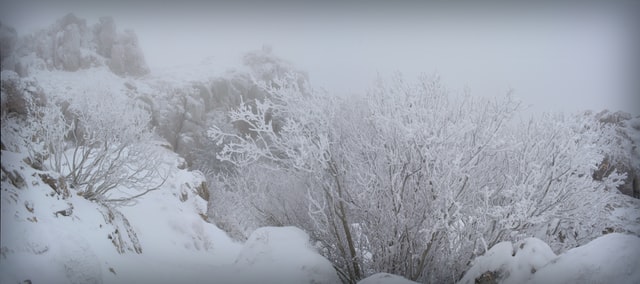
The air grew increasing chilly. Frills of frost appeared on the hedges and visible tendrils of breath spilled from Moonsprite’s nostrils. Flakes of snow began to fall. Sinead shivered and drew her cloak around her.
On they climbed through the ever-thickening snow.Sinead placed her hand on the hilt of her sword. This time Moonsprite sent no calming message to her, as she had back in the Garden. Sinead placed her other hand on Moonsprite’s neck, urging her to stop. The snow-white unicorn halted, stamping her hooves on the icy stone, while Sinead opened the saddlebag. She took out the Prophesy Book and opened it.









 luna's on line