
Today’s stop on our literary journey through my novels takes us to a specific part of Liverpool. From the pages of You’ll Never Walk Alone, we visit one of best-known and best-loved traditional hostelries in the city, The Philharmonic Dining Rooms, commonly known as ‘The Phil’.
Built at the beginning of the 20th century, the building is an architectural gem. The interior is ornately decorated using musical themes that relate to the concert hall across the road. Two of the smaller side rooms are appropriately named, ‘Brahms’ and ‘Liszt’ and, although I don’t mention them by name, it is in one of these rooms that Ruth and Connor settle themselves in the excerpt below. Also of note in this splendid location are the gentlemen’s urinals, which are made from rose-coloured marble (ladies are allowed to take a peek when it’s not busy, and yes, of course I’ve been for a look).

This grand public house is popular with folk from all walks of life, but especially ‘arty’ types like writers and musicians, and students. Close to the campus of the University of Liverpool, where I studied back in the early 1980s when the novel is set, it was always a popular stop on the way into town of an evening. Connor would be in his element here, and indeed in any bar!
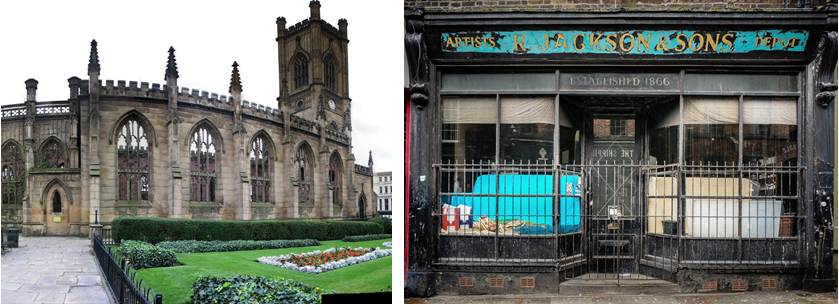
Connor and Ruth arrive at ‘The Phil’ by way of St. Luke’s Gardens, where they first meet up. Better known as the ‘Bombed Out Church’, St. Luke’s another well-known Liverpool landmark, popular for assignations of various kinds. The church was badly bombed during the WWII and only the shell remains, but the gardens, even then, were nicely kept and were open to the public during the day.
One final note: there is an art supplies shop in Slater Street, called Jackson’s. One of those ‘proper’ old shops, which has been there since the late 1890s. Past customers include famous Liverpool artists, Augustus John and Stuart Sutcliffe. I had a friend who worked there. I suppose that Ruth might have been very, very loosely based on her. Don’t let the unprepossessing photo put you off. It’s changed a bit since the photo below was taken, although this is more how I remember it.
Excerpt from You’ll Never Walk Alone
Ruth checked that the back door was locked and bolted, snatched up her keys and handbag, and picked up a package from the counter. She fastened her coat and pulled the hood over her short blonde hair before stepping out into the early evening drizzle. She quickly double-locked the front door and padlocked the wrought iron gates over the shop front of Windsor’s Art Supplies, the family shop which her great, great-grandfather had opened in 1879.
She glanced up and down Slater Street, then crossed the road into the narrow street opposite. The heels of her shoes struck the pavement determinedly. A few minutes later she was hurrying across the busy road towards the gardens of the bombed-out church of St Luke’s. The cathedral clock further up the hill was just striking five o’clock as Ruth entered the church gardens. Her eyes followed the pathway as she searched for the man she was meeting. The gardens were all but deserted, the wooden benches set at intervals around the pathway empty apart from one.
As Ruth approached the man stood up and raised his hat to her. “Good evening to you,” he said. “Thank you for coming.” He smiled and held out his hand. “They call me ‘The Poet’,” he said, gazing intently into her eyes.
Ruth introduced herself and shook his hand firmly.
“Please join me on my solitary pew, Miss Windsor,” he continued, indicating the damp bench with a sweeping gesture. Ruth detected an Irish accent. She noticed his striking blue-green eyes which lit up his craggy face. For an older man, she found him really rather attractive.
Ruth tucked her coat under her as she sat down. The rain had stopped, but water continued to drip from the trees and bushes.
She was puzzled though. “The Poet? I was expecting someone else. The order was placed by…”
“My associate, Pierre Bezukhov.” Connor said triumphantly. “You do have the painting for me then?”
All along she’d thought it was strange that her client had wanted to meet her away from the shop, and now he’d sent someone else to pick up the painting. Still, a commission was a commission. Shrugging her shoulders, Ruth handed him the package.
Taking it from her he fingered the packaging: “Shall we take a little look?” It had started to rain again. Connor looked skyward. “But not here. Let’s get out of the weather.” Turning to Ruth he said: “Miss Windsor, would you care to accompany me to a nearby hostelry, to seal the deal with a little drink as it were..?”
Ruth hesitated. “Well…”
“Dear Miss Windsor, I would really like to have a look at it while you’re with me.” Connor looked at her intently.
Ruth stared back at him. “All right, fine.”
“The Phil?”
“Okay, let’s go before we get any wetter.”
They left the gardens and hurried up the road to The Philharmonic Dining Rooms, the grand Victorian pub known for its rich tiling, stained glass and chandeliers, and of course, its wide selection of alcoholic beverages.
There were only a handful of people standing around the bar area when they arrived. They selected an empty corner in one of the small side rooms and Connor went to fetch their drinks. Ruth took off her coat and smoothed down her skirt. She eyed the package which The Poet had left on the table between them.
Connor returned empty-handed. “So sorry Miss Windsor, I appear to have forgotten my wallet.”
Ruth fished in her handbag and retrieved a scrunched up five pound note from its depths. She held it out to him. “Please, do call me Ruth, especially if I’m buying.”
Connor took the note with a slight bow and hurried back to the bar. He returned with a pint of Guinness and a gin and tonic. He piled up the change on the table in front of her. She scooped up the notes and coins and dropped them into an inner recess of her bag.
Connor lifted his glass and took a generous mouthful. Putting the drink down, he picked up the painting, then having untied the wrapper carefully he peeked inside.
Ruth leant towards him over the table and whispered: “The Turner, as ordered.” She took a sip of her drink.
Connor looked up, his eyebrows raised over those striking blue-green eyes. “An original?”
Ruth frowned. “No, of course not. You don’t know?” she paused. Something was wrong. “This is exactly as the client requested,” she whispered across the table.
“Yes. Yes of course. Just picking it up for a friend don’t you know?” The Poet sounded doubtful. He re-tied the wrapper and took a large pull on his pint. Cradling the painting in his lap, he looked earnestly at Ruth: “He did pay for it, I trust?”
“Well,” said Ruth slowly, “he gave me a bank deposit slip for the payment. Otherwise I wouldn’t have completed the commission for him.”
“Sure he did. Of course.” Connor nodded thoughtfully. There was something fishy going on. A forgery? No, surely just a copy. Ruth didn’t strike him as someone who’d be mixed up in something underhand. If he did take the painting from her, and she seemed quite prepared to let him have it, what was the worst that could happen?
“Listen, Miss Windsor… Ruth… here’s the receipt I got from… er, Mr Bezukhov,” Connor held out the crumpled piece of paper. Is there something you need me to sign?
Ruth rummaged in her bag and pulled out a well-used receipt book and a pen. She leaved through the pages. “Here we are,” she said, placing the book in front of him and pointing. “Just sign here.”
Connor quickly scribbled an indecipherable squiggle and passed the book back to her. “Thank you Ruth, it’s been a pleasure meeting you.” He drained his glass and tucking the painting under his arm, stood up. “Maybe our paths may cross again.” He smiled, blue-green eyes twinkling, as he raised his hat to her.
You’ll Never Walk Alone is available in paperback and ebook
Image credits: Rodhullandemu, Bryan Ledgard, theguideliverpool.com and Vici MacDonald









 luna's on line